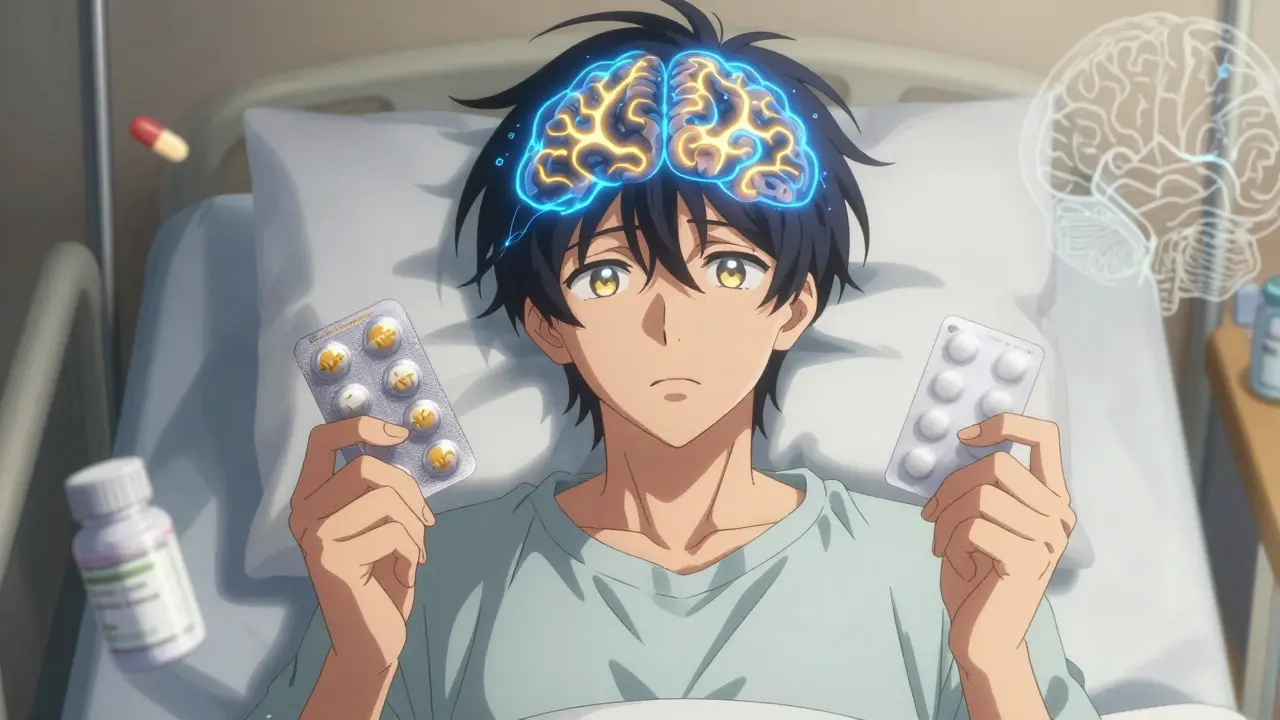
Switching from a brand-name drug to a generic feels like a simple cost-saving move-until it doesn’t. You take the same pill, same dose, same active ingredient. But something feels off. Your headache doesn’t lift as fast. Your anxiety creeps back. Your blood pressure climbs. You’re not imagining it. And it’s not because the generic is weaker.
The real culprit? Your brain.
Decades of research show that what you believe about a medication can change how well it works-even if the chemistry is identical. This isn’t magic. It’s biology. And it’s happening right now to millions of people who switched to generics without knowing what to expect.
Why Your Brain Believes Brand Names Work Better
In 2014, researchers at the University of Auckland gave people fake painkillers. Half got pills labeled as a well-known brand-name drug. The other half got identical pills labeled as a generic. Both groups got placebos-no active ingredient at all.
The brand-labeled group reported pain relief nearly as strong as real ibuprofen. The generic-labeled group? Their pain dropped, but only by about half as much.
This isn’t an isolated case. Similar studies have shown the same pattern with antidepressants, statins, and even blood pressure meds. When patients think they’re taking a brand-name drug, their brains release more natural painkillers. Their stress hormones drop. Their nervous system calms down. It’s not placebo in the sense of "it’s all in your head." It’s placebo in the sense that your head changes your body.
Brain scans confirm this. When people believe they’re taking a branded drug, the dorsolateral prefrontal cortex-the area tied to expectation and reward-lights up 27% more than when they think they’re taking a generic. That extra brain activity directly links to how much pain they say they feel.
The Cost-Per-Pill Illusion
It’s not just the name on the bottle. Price matters too.
In one study, healthy volunteers were given fake painkillers. Some were told the pill cost $2.50. Others were told it cost 10 cents. Both pills were identical. The $2.50 pill reduced pain by 64% more than the 10-cent pill.
That’s not about value. It’s about belief. We’ve been trained to think expensive = better. That’s true for phones, cars, and coffee. But it’s not true for medicine. A generic atorvastatin pill costs $0.08. The brand-name Lipitor? $4.83. Same molecule. Same effect. But if you believe the cheap one is weaker, your body acts like it is.
And that belief isn’t random. It’s shaped by ads, packaging, even the color and shape of the pill. The FDA found that changing a generic’s appearance-like switching from a blue capsule to a white tablet-increased patient reports of side effects by nearly 30%. Why? Because it looked different. And different felt like "not the same."
When Generics Feel Like They Don’t Work
On forums like Drugs.com and Reddit, hundreds of patients describe the same experience:
- "I was stable on brand-name levothyroxine. Switched to generic. My TSH shot up. I felt exhausted. My doctor said it’s the same-so why do I feel worse?"
- "I took generic sertraline for a month. My anxiety got worse. I went back to the brand. Instant improvement. I know they’re chemically identical, but my brain knew the difference."
- "My pharmacist switched me to generic statin without warning. I started having muscle pain. I thought it was the drug. Turns out, I had no muscle damage. Just the nocebo effect."
This isn’t about poor quality. The FDA requires generics to match brand-name drugs in absorption, strength, and performance within a very tight range-80% to 125% of the original. That’s not a loophole. That’s science. These pills work the same way.
But here’s the catch: the difference between feeling okay and feeling awful isn’t always chemical. Sometimes, it’s psychological. And when you’re already anxious about your health, that gap feels huge.

The Nocebo Effect: When Expectations Make You Sicker
There’s a flip side to the placebo effect: the nocebo effect. That’s when you expect something to cause harm-and it does.
In statin trials, patients told they were taking a generic reported muscle pain at nearly 3 times the rate of those told they were taking a brand-name drug-even when both were placebos. In one study, 11% of patients on generic-labeled placebos reported fatigue. The same number in the general population reports chronic fatigue. That’s not coincidence. It’s suggestion.
Doctors don’t always warn patients about this. They say, "It’s the same drug." But that’s not enough. If you’ve been told your brand-name drug kept you alive, and now you’re handed a cheaper version with a different logo, your brain doesn’t hear "same." It hears "compromise."
How Doctors Can Help-Without Lying
It’s not about tricking patients. It’s about guiding them.
A 2021 study in JAMA Internal Medicine tested a simple 3-minute conversation. Doctors told patients:
- "Generic drugs are required by the FDA to work exactly like the brand name. They have the same active ingredient, same dose, same effect."
- "Some people feel different when they switch-not because the drug is weaker, but because their brain expects it to be."
- "Give it two weeks. If you still feel off, we’ll talk. But don’t assume it’s the medicine.”
Result? Nocebo responses dropped by 47%. Adherence went up. Patients stayed on generics longer. And no one was lied to.
Training programs for providers now include this exact script. Clinicians who use it see 32% higher success rates in keeping patients on generics. It’s not about persuasion. It’s about preparation.

What You Can Do
If you’re switching to a generic:
- Ask your doctor to explain the switch. Don’t just accept it. Ask: "Will this work the same? What should I expect?"
- Don’t panic if you feel different at first. Give it 10-14 days. Your body and brain need time to adjust to the new label.
- Track your symptoms. Write down how you feel before and after the switch. Is it really worse-or just different?
- Don’t assume cost = quality. A $0.08 pill can save your life just like a $4.83 one.
- If you’re still struggling, talk to your pharmacist. They can check if the generic’s appearance changed. Sometimes, a color or shape shift triggers the nocebo effect.
And if you’re still convinced the generic isn’t working? Talk to your provider. Sometimes, the right answer is to switch back. But make sure it’s because of real symptoms-not just fear.
The Bigger Picture
The U.S. spends $1.4 billion a year on brand-name drugs that could’ve been generics-because people believed they needed the more expensive version. That’s not just waste. It’s a failure of communication.
Meanwhile, the FDA is now requiring generic manufacturers to keep pill shapes and colors consistent across batches. Why? Because changing them causes more people to quit taking their meds. That’s not regulation. That’s psychology.
And in Europe, a €2.4 million study is underway to create standardized patient education materials for generics-because they know the problem isn’t the drugs. It’s the mindset.
By 2028, fixing this could save the U.S. healthcare system $8.7 billion a year. That’s not a guess. That’s a projection from Evaluate Pharma, based on real adherence data.
The truth is simple: generics work. But they work better when you believe they do.
It’s not about being gullible. It’s about understanding that your mind is part of your medicine.
Are generic drugs really the same as brand-name drugs?
Yes. The FDA requires generics to contain the same active ingredient, strength, dosage form, and route of administration as the brand-name drug. They must also meet the same strict standards for quality, purity, and performance. Bioequivalence testing ensures that the generic is absorbed into your bloodstream at the same rate and to the same extent as the brand. The only differences are in inactive ingredients (like fillers or dyes) and packaging-none of which affect how the drug works in your body.
Why do some people feel worse after switching to a generic?
It’s often not the drug-it’s the expectation. If you’ve been on a brand-name drug for years and believe it’s superior, your brain may interpret the switch as a downgrade. This can trigger the nocebo effect: you start noticing side effects or reduced effectiveness because you expect them. Studies show that even when the medication is identical, patients report more symptoms when told they’re taking a generic. The physical difference doesn’t exist-but the psychological one does.
Can the placebo effect make a generic drug actually work better?
Yes. If you believe you’re taking a brand-name drug-even if it’s a generic-the placebo effect can boost its real-world effectiveness. Brain imaging shows stronger activation in areas linked to expectation and pain control when patients think they’re using a branded product. This doesn’t change the drug’s chemistry, but it does change how your body responds to it. That’s why some patients feel better when they’re unaware they switched to a generic.
Should I avoid generics because of the placebo effect?
No. Generics are safe, effective, and save patients and the system billions each year. The placebo effect doesn’t make them less reliable-it just means your mindset matters. The solution isn’t to avoid generics, but to understand how expectations shape outcomes. Talk to your doctor before switching. Get educated. Give yourself time to adjust. Most people adapt without issue.
How can I tell if my symptoms are from the drug or my mindset?
Track your symptoms before and after the switch. Are they new? Or did they exist before? Did your lab results change? If your blood pressure, thyroid levels, or cholesterol numbers are still in range, your body is responding to the drug. If you feel worse but your numbers are stable, your brain may be influencing your perception. Talk to your provider. They can help you distinguish between physical changes and psychological ones.
Is it ethical for doctors to let patients believe they’re taking a brand-name drug?
Deliberately misleading patients is never ethical. But educating them about the role of expectation is. Doctors shouldn’t hide that a drug is generic. They should explain that the difference isn’t in the pill-it’s in the perception. The goal isn’t to trick you into feeling better. It’s to help you understand why you might feel different-and that it’s not a sign the drug failed.
What’s being done to fix this problem?
The FDA now requires generic manufacturers to keep pill appearance consistent to reduce confusion and nocebo responses. Medicare plans are training pharmacists to have expectation-management conversations. In Europe, a €2.4 million study is developing standardized patient education tools. A digital program called the "Expectation Modulation Protocol" has already shown a 53% reduction in nocebo effects in clinical trials and is under FDA review. The goal? Make sure the science of the drug isn’t undermined by the psychology of the patient.
Final Thought
Medicine isn’t just chemistry. It’s communication. It’s trust. It’s belief.
Generics are not second-rate. They’re the same medicine, priced fairly. The gap between perception and reality isn’t a flaw in the drug-it’s a flaw in how we talk about it.
Next time you pick up a prescription, ask yourself: Is this about the pill-or the story you’ve been told about it?





Bryan Fracchia
January 27, 2026 AT 22:37It’s wild how much our minds shape reality-even when the pill’s the same. I used to swear my generic thyroid med wasn’t working, until I realized I was stressing over the fact that it looked different. Once I stopped fighting the idea that it was ‘lesser,’ my symptoms smoothed out. Turns out, my brain was the problem, not the pharmacy.
Lance Long
January 29, 2026 AT 04:24Let me tell you something-this isn’t just about pills. It’s about trust. We’ve been sold the idea that more expensive means better since we were kids. Nike shoes, iPhones, coffee… and now, our meds? Same script. But here’s the twist: your body doesn’t care about branding. It cares about consistency. And if your doctor doesn’t explain that before switching you? That’s not negligence-it’s betrayal.
I’ve seen patients cry because they think they’re ‘failing’ their treatment. But it’s not failure. It’s conditioning. We need to rewire this. Not with more ads. Not with more labels. With honest, human conversations.
Timothy Davis
January 29, 2026 AT 06:48Let’s cut through the fluff. The placebo effect is real, sure-but let’s not pretend it’s some mystical force. The bioequivalence range (80–125%) is a legal loophole, not a scientific guarantee. Some generics *do* have different absorption profiles. The FDA doesn’t test for *clinical* equivalence-only pharmacokinetic. So when someone says ‘it’s the same,’ they’re either lying or misinformed.
And don’t get me started on the color-shifting generics. That’s not psychology-it’s bad manufacturing. If you change the pill’s appearance without warning, you’re not helping patients-you’re creating confusion. The real issue isn’t belief. It’s sloppy regulation disguised as cost-saving.
And yes, the nocebo effect exists. But that doesn’t excuse systemic failures. Stop blaming the patient’s brain and fix the system.
Amber Daugs
January 30, 2026 AT 08:40Oh please. People are just being dramatic. If you can’t handle switching to a cheaper pill, maybe you’re not ready for adulting. Your brain isn’t a magic wand-it’s a lazy organ that wants the shiny version. Grow up. Stop treating yourself like a fragile child who needs branded comfort blankets.
And if you’re still whining after two weeks? Then maybe you’re just lazy. Or addicted to the drama. I’ve been on generics for 12 years. No issues. No ‘nocebo.’ Just common sense.
Jeffrey Carroll
January 30, 2026 AT 09:53The science here is compelling, but the emotional weight of this issue is often overlooked. Many patients have spent years on a brand-name medication-sometimes after life-threatening conditions-and the switch feels like a loss of control. It’s not irrational to grieve that. The healthcare system treats this as a logistical change, not a psychological transition.
There’s dignity in continuity. When we strip away familiarity without acknowledging its emotional value, we risk eroding trust in the entire medical system. The solution isn’t just education-it’s empathy. A 3-minute script helps, but what if we trained providers to listen first, explain second?
Phil Davis
January 31, 2026 AT 20:53So let me get this straight: we’ve spent billions on pharma marketing telling us brand = better… and now we’re surprised people believe it? Shocking. Next you’ll tell me people think ‘organic’ means ‘not poison.’
The real tragedy? The system knew this would happen. They knew changing pill colors would trigger nocebo. They knew price anchoring affects perception. And yet, they kept doing it-because profit margins matter more than patient trust.
It’s not that patients are gullible. It’s that the system is rigged to exploit gullibility.
Irebami Soyinka
February 2, 2026 AT 01:34HAHA! America again-spending billions on brand-name drugs because you think the color of the pill makes it holy? 😂 We in Nigeria use generics daily-no drama, no panic. If it’s FDA-approved, it works. If your brain is weak, maybe you need a stronger mind, not a more expensive pill. 💪🏽💊
Stop making medicine a psychological circus. Take the pill. Shut up. Live.
Mel MJPS
February 2, 2026 AT 23:28I just wanted to say thank you for writing this. I switched to generic sertraline last year and felt like I was going crazy-like my anxiety had returned with a vengeance. I was ready to quit meds entirely. But then I read something similar to this and gave it two weeks. I didn’t realize how much I’d been scared of the change. Now? I’m stable. And I feel so much better knowing it wasn’t me failing-it was my fear.