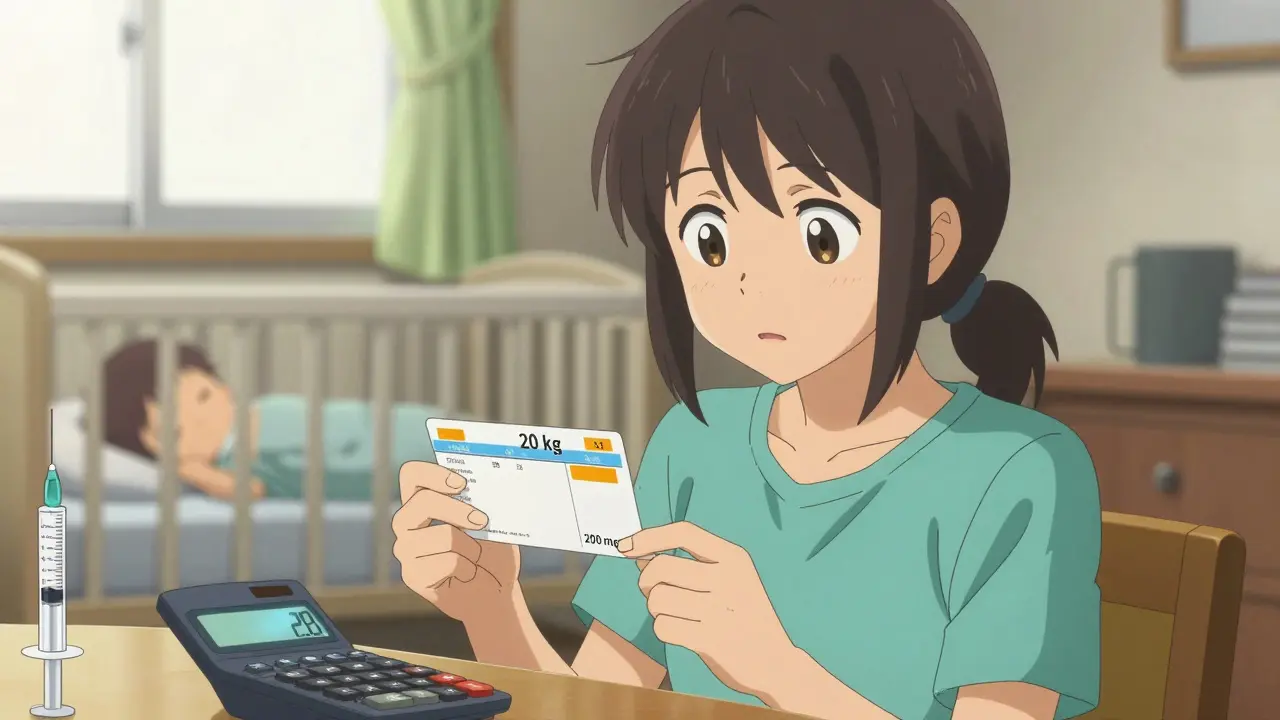
When your child gets a prescription, the label might say 10 mL - but that’s not the dose. The real dose is in milligrams. And if you miss that, you could be giving your child too much - or too little - medicine. In fact, nearly half of all preventable medication errors in kids happen because someone confused the volume (mL) with the actual drug amount (mg). This isn’t a rare mistake. It’s happening in homes, pharmacies, and even hospitals. But you can stop it. Here’s exactly how to confirm pediatric dosing on a child’s prescription label - step by step.
Start with the child’s weight in kilograms
Pediatric doses aren’t based on age alone. They’re calculated using weight. And in the U.S., doctors often record weight in pounds. But the math for safe dosing? It’s done in kilograms. That’s because every medication guideline - from amoxicillin to chemotherapy - uses mg/kg (milligrams per kilogram). If the label says "200 mg" but doesn’t show the weight in kg, ask for it. A 2022 study found that 22.4% of dosing errors came from wrong weight conversions.Here’s how to convert: Take the child’s weight in pounds and divide by 2.2. For example: a 44-pound child = 44 ÷ 2.2 = 20 kg. That’s the number you need to use. If the prescription says "40 mg/kg/day," you now know the total daily dose is 800 mg (20 kg × 40 mg/kg). Never trust a label that only gives you pounds. Always ask for the weight in kg.
Look for the dose in milligrams, not milliliters
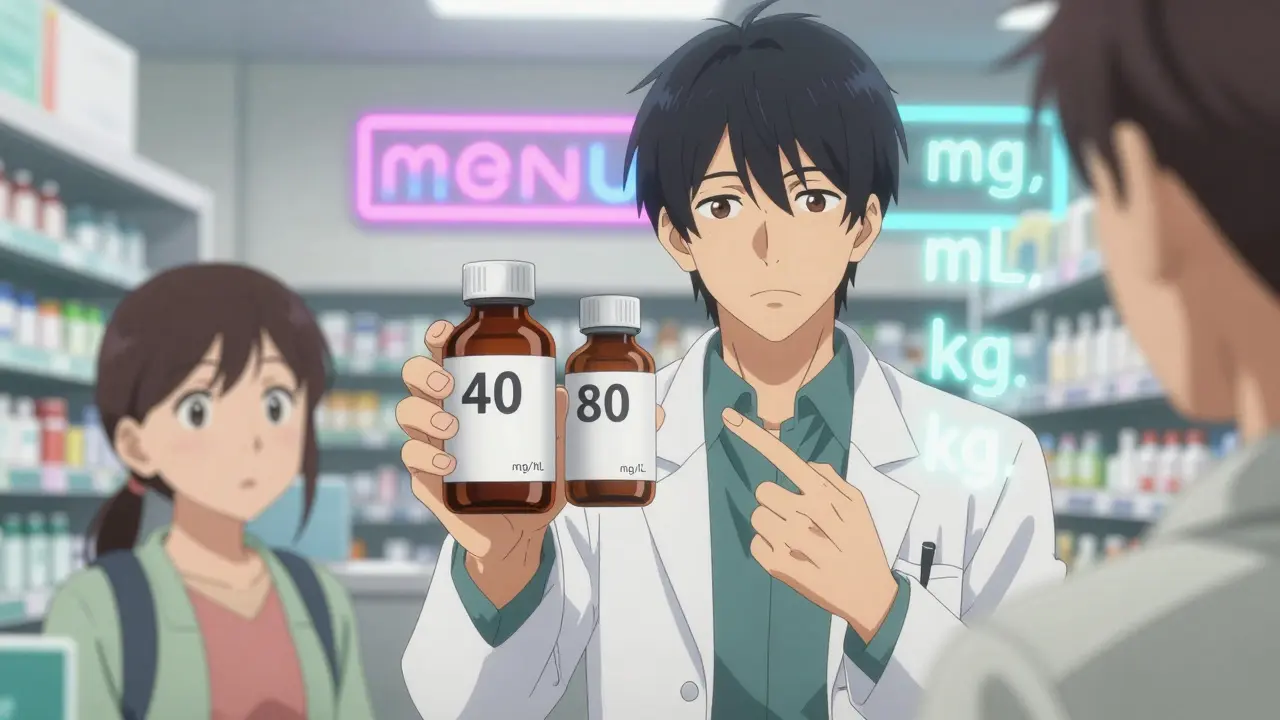
This is the most dangerous mistake parents make. A label might say: "Take 10 mL twice daily." But what’s in that 10 mL? Is it 100 mg? 250 mg? 500 mg? You can’t know unless it’s written out.Some liquid medications come in different concentrations. Amoxicillin, for example, can be 40 mg/mL, 80 mg/mL, or even 125 mg/mL. If you’re used to one concentration and the pharmacy switches it without telling you - and you don’t check - you could give your child 2.5 times the right dose. That’s not hypothetical. A mother in Pennsylvania nearly overdosed her 4-year-old because she didn’t realize the new bottle had a different strength.
Ask: "What is the exact dose in milligrams?" Not milliliters. Not teaspoons. Not drops. Milligrams. The label should clearly state both: "Give 200 mg (2.5 mL)." If it only says "2.5 mL," that’s not enough. Call the pharmacy. Ask them to print a corrected label. You have the right to demand clarity.
Verify the dose matches the weight-based guideline
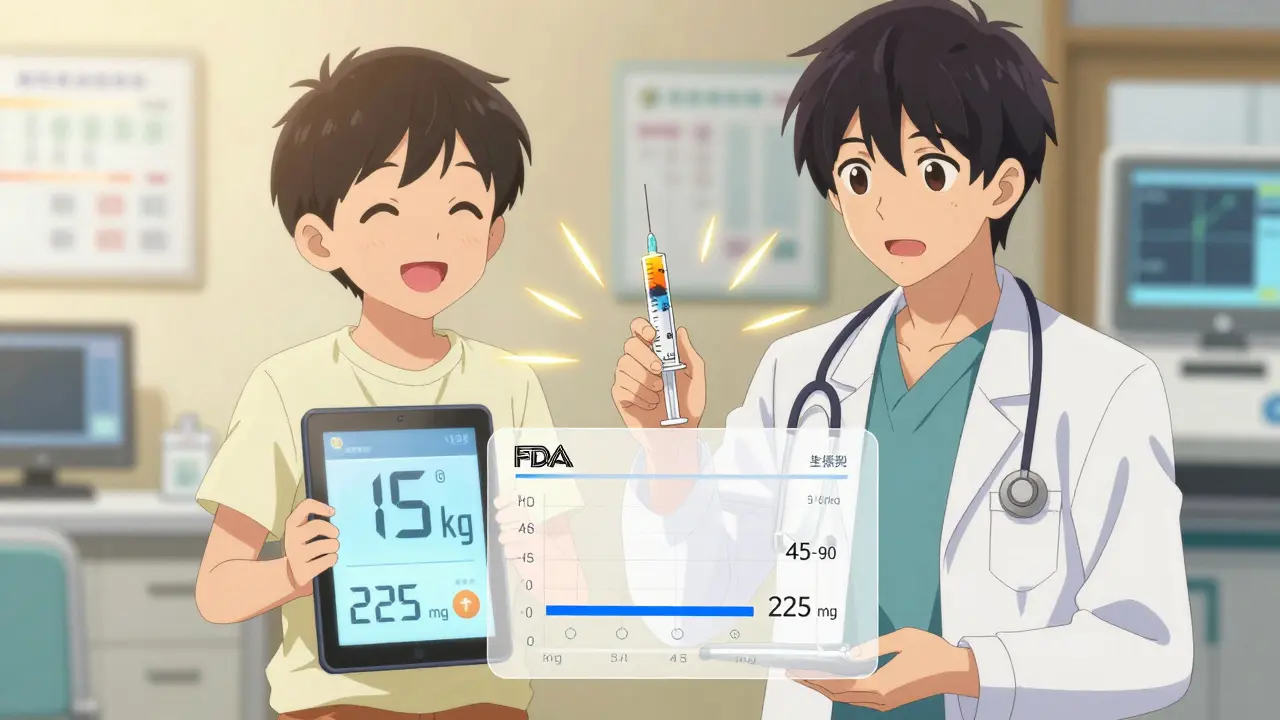
Once you have the weight in kg and the dose in mg, cross-check it. For common antibiotics like amoxicillin, the standard dose is 45-90 mg/kg/day, divided into two or three doses. For acetaminophen (Tylenol), it’s 10-15 mg/kg/dose every 4-6 hours. If your child weighs 15 kg and the label says 500 mg per dose - that’s 33 mg/kg. That’s within range. If it says 750 mg? That’s 50 mg/kg. Still okay. But if it says 1,000 mg? That’s 67 mg/kg. Way above the safe max.Use the FDA’s Safe Use of Pediatric Liquid Medicines guide (2023) as your reference. It lists standard doses for common drugs. You don’t need to memorize them. Just use them as a check. If the dose seems too high for how small your child is - trust that feeling. Ask the pharmacist: "Is this dose appropriate for my child’s weight?" They’re trained to catch these errors. Let them help you.
Check the concentration on the bottle
Every liquid medication bottle has two numbers you need to compare: the total amount of drug (in mg) and the concentration (mg/mL). If the label says "Amoxicillin 400 mg/5 mL," that means each mL contains 80 mg. So if the prescription says "200 mg," you need 2.5 mL. But if the bottle says "80 mg/mL," and you think it’s 40 mg/mL, you’ll give twice as much.Pharmacists are required to print the concentration on the label. If it’s missing - ask for it. The FDA mandated this in 2021. If you’re given a syringe, make sure it matches the concentration. A syringe marked "1 mL = 80 mg" should only be used with an 80 mg/mL solution. If it’s labeled "1 mL = 40 mg," you need to use a different syringe. Never guess. Always match the numbers.
Use the dosing device provided - never a kitchen spoon
A teaspoon is not a standard unit. A kitchen teaspoon holds anywhere from 3 mL to 7 mL. That’s a huge range. The same goes for cups, droppers, or medicine bottles with unclear markings.Always use the device that came with the medicine. It’s calibrated for that specific concentration. If the label says "Give 5 mL," use the syringe or measuring cup that came with the bottle. Don’t use a different one. Don’t estimate. If you lost the device, go back to the pharmacy. They’ll give you a new one - for free. Many pharmacies now include color-coded syringes that match common pediatric doses. That’s not a gimmick. It’s a safety tool.
Require dual verification - from both pharmacist and provider
The American Society of Health-System Pharmacists (ASHP) says every pediatric dose should be checked by two people. One person calculates. The other confirms. That’s standard in hospitals. But at your local pharmacy? It’s not always done.Ask the pharmacist: "Did you verify this dose using the child’s weight?" If they say "yes," ask them to show you how. They should say something like: "Ordered: 200 mg, calculated from 18 kg × 11 mg/kg." That’s the gold standard. If they just say "it looks right," push back. You’re not being difficult. You’re preventing a life-threatening error.
Also, ask the prescribing doctor: "Did you write the dose in mg/kg?" Since January 1, 2024, the American Academy of Pediatrics requires all pediatric prescriptions to include the child’s weight in kg and the calculated dose in mg. If the prescription doesn’t have it - it’s incomplete. That’s not just best practice. It’s policy now.
Watch for rounding errors
Sometimes, the math gives you a weird number. Like 1.87 mL. That’s hard to measure. Pharmacies often round it to 1.9 mL or 2 mL. But that small change can matter. For a 3-month-old, 0.1 mL could mean the difference between a safe dose and a toxic one.Electronic systems like EPIC and Cerner have rules for this. If the dose is under 10 mg, they round to the nearest 0.1 mg. If it’s over 10 mg, they round to the nearest 1 mg. But you won’t see those rules on the label. So if the dose seems oddly precise - like 1.87 mL - ask: "Was this rounded? What was the original calculation?" If they say yes, ask: "Is the rounded dose still within safe limits?" Sometimes, rounding up is fine. Sometimes, it’s not. You need to know.
Trust your gut - and document everything
Parents who catch dosing errors often say the same thing: "It just didn’t feel right." That’s not paranoia. That’s intuition built from experience. If the dose seems too big for a 20-pound toddler - it might be. If the label looks messy or handwritten - be suspicious. If the pharmacist seems rushed - ask for more time.Keep a simple log: Write down the date, drug name, weight in kg, prescribed dose in mg, concentration, and volume you gave. If something goes wrong - like a reaction or side effect - you’ll have proof of what was given. This isn’t just for peace of mind. It’s your legal right to document your child’s care.
Technology is helping - but you still need to verify
New tools are making this easier. Some EHR systems now auto-calculate doses based on weight. Smart pumps in hospitals check the child’s weight from connected scales. AI tools like DoseSpot cross-reference 15,000+ guidelines before approving a dose. But none of these are perfect. And none replace your role as the final safety check.Even with 99% accurate systems, human error still slips through. That’s why the most successful pediatric units don’t rely on tech alone. They rely on people asking questions. You are one of those people. Your vigilance saves lives.
What should I do if the prescription label doesn’t list the child’s weight in kilograms?
Call the pharmacy or prescribing provider immediately. Ask them to rewrite the prescription with the child’s weight in kilograms (kg) and the dose in milligrams (mg). Since January 1, 2024, the American Academy of Pediatrics requires this format for all pediatric prescriptions. If they refuse, ask to speak with the pharmacist-in-charge. You have the right to a clear, safe label.
Why is it dangerous to use a kitchen spoon to give liquid medicine?
A kitchen spoon varies in size - from 3 mL to 7 mL - and isn’t calibrated for medicine. Using one can lead to underdosing (if the spoon holds less) or overdosing (if it holds more). The FDA and CDC recommend using only the dosing device that comes with the medication, which is designed to deliver the exact volume needed. A teaspoon of medicine isn’t the same as a medical teaspoon.
Can I trust the pharmacy if they say the dose is "standard"?
No. "Standard" doesn’t mean safe for your child. Every child’s weight, age, and health condition changes how much medicine they need. A "standard" dose for a 50-pound child might be 10 times too much for a 10-pound infant. Always verify the dose is calculated using your child’s actual weight in kilograms. Ask the pharmacist: "Did you use my child’s weight to calculate this?"
What if the label says "10 mL" but doesn’t say how many milligrams that is?
Do not give it. Return to the pharmacy and demand a corrected label. Since 2021, the FDA requires all pediatric liquid medications to include both the total dose in milligrams and the volume in milliliters on the label. If it’s missing, the prescription is incomplete. Ask for the concentration (e.g., 80 mg/mL) and calculate the dose yourself: (Volume × Concentration = Total mg). If you can’t do it, ask the pharmacist to show you.
Are there any tools or apps that can help me verify pediatric doses?
Yes. The FDA’s "Safe Use of Pediatric Liquid Medicines" guide is available online and lists standard doses. Apps like DoseSpot and Medscape’s Pediatric Dose Calculator are used by clinicians and can be accessed by parents. But remember: these are tools, not replacements for double-checking. Always match the numbers on the label with what you calculate. If the app says 150 mg and the label says 250 mg - don’t assume the app is wrong. Ask the pharmacist why.





Kal Lambert
March 19, 2026 AT 12:16Emily Hager
March 19, 2026 AT 17:40My daughter’s pediatrician literally wrote the dose as "45 mg/kg/day" on the prescription pad. The pharmacy printed it on the label. No confusion. No guesswork.
Yet here we are, in 2024, treating parents like they need a PhD in pharmacology just to give Tylenol.
The system is broken. Not because parents are dumb. Because the healthcare industry refuses to standardize. And now we’re all stuck cleaning up the mess.
Linda Olsson
March 21, 2026 AT 15:54Every time you ask for the weight in kg, you’re stepping into a system designed to keep you out.
Pharmacists? They’re trained to say "it’s standard." Doctors? They’re rushed.
And the FDA? They mandate labels but don’t audit.
I’ve seen it. A mom in my neighborhood gave her 3-year-old 10 mL of amoxicillin because the label said "10 mL" - turned out it was 125 mg/mL, not 250 mg/mL. She didn’t know. The pharmacist didn’t check.
Now? The kid’s in kidney rehab.
They don’t want you to ask questions. They want you to trust. And trust gets kids killed.
Melissa Starks
March 22, 2026 AT 13:32My son had a reaction last year because I trusted the label that said "Give 5 mL" - no mg listed. I didn’t know the concentration had changed from 125 to 250.
I felt so stupid. Like I should’ve known.
But here’s the thing - no one ever taught me how to read a pediatric label. Not in prenatal class. Not at the hospital. Not even from my own pediatrician.
So I started writing it down: date, weight, dose, concentration, volume. I keep it in a little notebook. My husband thinks I’m overkill.
But when the nurse at the ER saw it? She said, "I wish every parent did this."
You’re not paranoid. You’re prepared. And that’s everything.
Lauren Volpi
March 23, 2026 AT 15:40We’re overcomplicating something that should be simple.
My cousin in Nigeria gives her kids medicine with a spoon. No labels. No syringes. No kg.
And guess what? Her kids are fine.
Meanwhile, we’ve turned a basic act of care into a bureaucratic nightmare.
Stop scaring parents. Just make the system work. Or stop pretending you care.
Melissa Stansbury
March 24, 2026 AT 22:36They said, "We don’t do that unless the doctor specifies."
I said, "The doctor wrote 40 mg/kg for a 15 kg child - that’s 600 mg. Can you print that?"
They paused. Then said, "We’ll call the doctor."
20 minutes later, I got a new label. It said: "600 mg (3 mL)."
I cried.
Not because I was scared. Because someone finally listened.
Ayan Khan
March 24, 2026 AT 23:52But this is not about culture.
This is about dignity.
Every child deserves to be seen as an individual - not a statistic, not a weight on a chart, not a number on a bottle.
The fact that we need a 10-step checklist to give a child medicine says more about our systems than about our care.
Perhaps the real question is not how to read the label - but why we made reading the label so hard.
Amadi Kenneth
March 25, 2026 AT 15:28But here’s what no one is saying:
What if the whole system is rigged?
Think about it - pharmaceutical companies profit from higher doses.
They design liquid formulations with multiple concentrations - knowing parents will mix them up.
They don’t standardize syringes.
They don’t enforce labeling.
And now? We’re all blaming parents.
But who benefits?
It’s not negligence. It’s economics.
And if you think this is an accident? You’re not paying attention.
Check the FDA’s 2023 report on pediatric medication errors.
87% of incidents involved a change in concentration.
And who changed it?
Not the parent.