
When you pick up a prescription at the pharmacy, the price you pay isn’t just about the drug itself. It’s shaped by your insurance plan’s copay structure - and whether you’re getting a generic or brand-name version makes a huge difference. In 2024, the gap between what you pay for a generic versus a brand-name drug isn’t just noticeable - it’s often dramatic. For many Americans on Medicare or private insurance, this difference can mean hundreds - even thousands - of dollars in out-of-pocket costs every year.
How Copay Tiers Work in 2024
Most prescription drug plans in the U.S. use a tiered system to control costs. Think of it like a ladder: the lower the tier, the cheaper your copay. The standard structure in 2024 has four or five tiers:
- Tier 1: Preferred Generic - Lowest cost, often $0 to $5
- Tier 2: Non-Preferred Generic - Slightly higher, usually $7 to $10
- Tier 3: Preferred Brand - Brand-name drugs your plan encourages, $40 to $60
- Tier 4: Non-Preferred Brand - More expensive brands, $100 or more
- Tier 5: Specialty - High-cost drugs for complex conditions, often 30% coinsurance or $150+
These tiers aren’t random. They’re designed to nudge you toward cheaper options. If your doctor prescribes a brand-name drug when a generic is available, your plan might charge you extra - sometimes the full price difference between the two. This is called "Member Pay the Difference," and it’s common in commercial plans like those from Blue Cross Blue Shield in Texas.
Average 2024 Copay Numbers
Here’s what real people paid in 2024 based on Medicare Part D and commercial plan data:
| Drug Type | Medicare Part D (MA-PD) | Medicare Part D (PDP) | Commercial Insurance |
|---|---|---|---|
| Preferred Generic | $4.50 | 22% coinsurance | 10-20% of drug cost |
| Non-Preferred Generic | $7 | 30% coinsurance | 15-25% of drug cost |
| Preferred Brand | $47 | 22% coinsurance | 30-40% of drug cost |
| Non-Preferred Brand | $100 | 47% coinsurance | 40-50% of drug cost |
| Specialty Drugs | $150-$5,030 | Up to 33% coinsurance | $150-$500+ per month |
Medicare Advantage Prescription Drug (MA-PD) plans tend to use fixed copays, which makes budgeting easier. Standalone Prescription Drug Plans (PDPs) more often use coinsurance - meaning you pay a percentage of the drug’s total cost. That can backfire badly if the drug is expensive. For example, if your brand-name drug costs $500 and your plan charges 47% coinsurance, you pay $235 - even if the generic version costs $10 and your copay is just $5.
Extra Help and Low-Income Caps
If your income is limited, you might qualify for Medicare’s Extra Help program. In 2024, this program capped copays at:
- Generic drugs: $4.50 per prescription
- Brand-name drugs: $11.20 per prescription
That’s a massive relief for people who need multiple medications. But here’s the catch: only about 25% of Medicare beneficiaries qualify. Everyone else pays full price - and that’s where the real pain shows up.
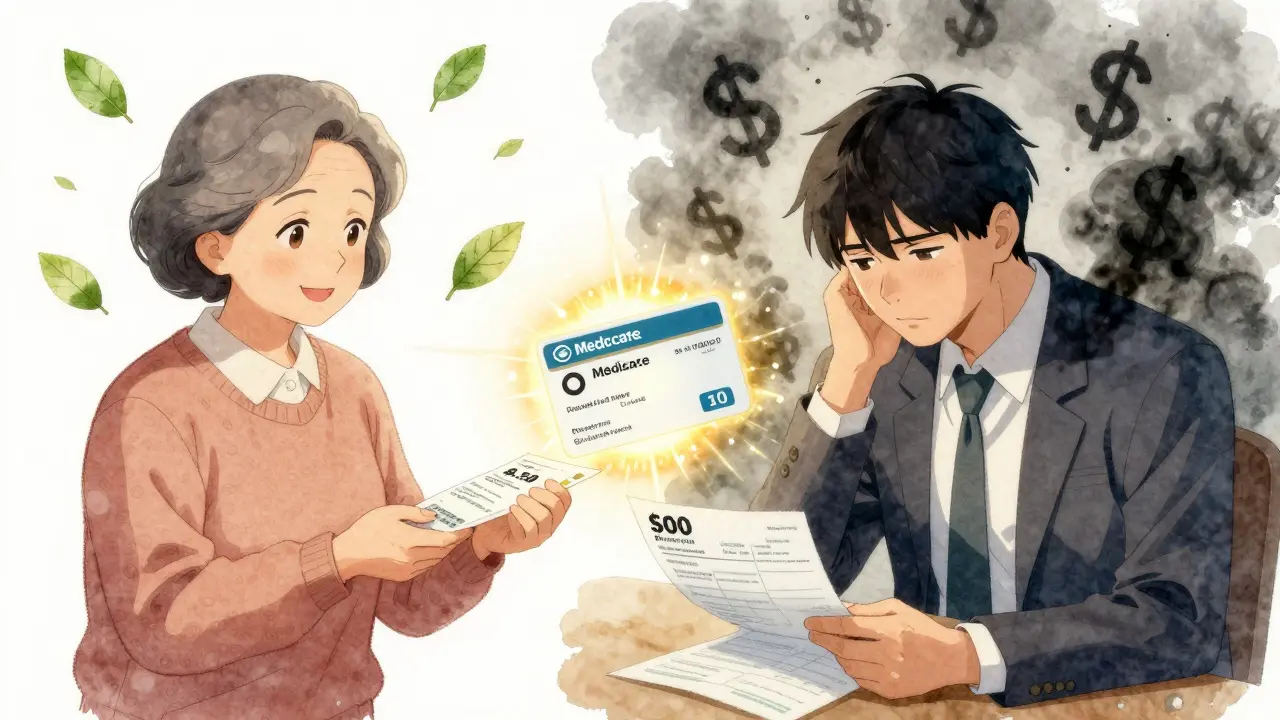
Why Brand Drugs Cost So Much More
Generic drugs are chemically identical to their brand-name counterparts. So why the huge price gap? It’s not about manufacturing - it’s about patents and market control.
Brand-name drug makers hold exclusive rights for years. During that time, they set high prices to recoup R&D costs. Once the patent expires, generics flood the market. Production becomes cheaper. Competition drives prices down. But your insurance plan doesn’t always reflect that savings.
Some pharmacies and wholesalers have been caught in "tying arrangements" - where they agree to higher prices on generics in exchange for better terms on brand drugs. This keeps generic prices artificially high, even when the actual cost to the pharmacy is low. Independent pharmacy owner Maria Rodriguez told industry researchers: "We often have to accept higher prices for generics to maintain favorable terms on branded drugs." That trick gets passed on to you at the counter.
Real Stories: What People Are Paying
One retiree in Florida told MedicareInteractive.org: "I pay $95 for a 90-day supply of my brand-name heart medication. The generic would cost $15. My doctor won’t switch me because of side effects." That’s $1,140 a year - just for one drug.
Another user on Reddit, u/PharmaPatient, described being hit with a $42 extra charge for choosing Lipitor over atorvastatin, even though their doctor wrote "dispense as written." The plan still charged them the difference - because the brand was on a higher tier.
Meanwhile, people using generics almost always report better experiences. Plans with $0 generic copays get 4.7/5-star ratings on Medicare Plan Finder. Plans with high brand copays? Around 3.2/5.

What’s Changing in 2025
The Inflation Reduction Act didn’t just tweak the system - it’s overhauling it. Starting in 2025:
- All Medicare Part D beneficiaries will have a $2,000 annual out-of-pocket cap - no matter how many brand drugs they take.
- 98% of plans will offer $0 copays for preferred generics (up from 87% in 2024).
- The $35 monthly cap on insulin applies to both generic and brand versions.
This means the gap between generic and brand costs will still exist - but the financial shock of hitting the coverage gap will vanish. For people on multiple expensive medications, this could save thousands.
How to Save Money Right Now
You don’t have to wait for 2025 to cut your drug costs. Here’s what actually works:
- Check your plan’s formulary. Every plan publishes it by October 15. Use the Medicare Plan Finder (or your insurer’s tool) to enter your exact medications. Don’t guess - compare actual numbers.
- Ask your doctor about alternatives. 72% of Medicare plans have a preferred generic for at least 80% of common brand drugs. Your doctor might not know your plan’s list - but you can.
- Use mail-order pharmacies. Many plans offer lower copays for 90-day supplies. That’s a 30% savings on some drugs.
- Ask about cash prices. Sometimes, paying cash at Walmart or Costco is cheaper than your copay. Use GoodRx or SingleCare to compare.
- Review your plan yearly. Your needs change. So should your coverage. A plan with a $5 generic copay might cost you $1,200 a year for a brand drug. Another with $40 brand copays might cost $480. It’s not about monthly premiums - it’s about total annual cost.
When to Get Help
If you’re taking three or more medications, consider a free plan review from the Medicare Rights Center or a local SHIP (State Health Insurance Assistance Program). These services are free. In 2023, audits of 500 cases found an average savings of $420 per person just by switching plans.
Don’t assume your plan is the best option. The system is designed to be confusing. But the numbers don’t lie: choosing the right drug and the right plan can cut your annual drug costs in half - or more.
Why are generic drugs cheaper than brand-name drugs?
Generic drugs are cheaper because they don’t require the same costly research, clinical trials, and marketing as brand-name drugs. Once a brand drug’s patent expires, other manufacturers can produce the same active ingredient. Competition drives prices down, and insurers reward this with lower copays. The FDA confirms generics are identical in safety, strength, and effectiveness - they’re just less expensive to make.
Can I ask my doctor to switch me from a brand to a generic?
Yes - and you should. Most brand-name drugs have generic equivalents. Your doctor may not realize your plan’s formulary or your financial strain. Bring up cost concerns directly: "Is there a generic version that works for me?" If your condition is stable, switching is often safe and effective. Only avoid it if you’ve had a documented reaction to a generic in the past.
Why did my pharmacy charge me extra for a brand-name drug?
Your plan likely has a "Member Pay the Difference" policy. This means if a generic is available and your doctor didn’t write "dispense as written," you pay your normal copay plus the full price difference between the generic and brand. For example, if the generic costs $10 and the brand costs $80, you pay your $10 copay plus $70 extra. This policy pushes you toward generics - but it can feel unfair if your doctor insists on the brand.
Do all insurance plans have the same copay tiers?
No. Medicare Part D plans follow federal guidelines, but commercial insurers set their own tiers. Some have three tiers, others have five. Coinsurance is more common in PDPs and bronze-level commercial plans, while MA-PD plans usually use fixed copays. Always check your specific plan’s formulary - never assume.
What should I do if I can’t afford my brand-name drug?
First, ask your doctor about alternatives on lower tiers. Then, check if the manufacturer offers patient assistance programs - most do. You can also use discount cards like GoodRx or SingleCare, which often beat insurance copays. If you’re on Medicare, apply for Extra Help through Social Security. If you’re still struggling, contact the Medicare Rights Center or your state’s SHIP program - they can help you appeal or switch plans.







Robert Shiu
February 20, 2026 AT 06:55Man, I wish I’d known about this years ago. My mom was paying $120 a month for a brand-name blood pressure med when the generic was $8. She didn’t even know she could ask her doctor to switch. Now she’s saving $1,300 a year - and she’s got more money for groceries and her grandkids’ birthday gifts. If you’re on meds, don’t just accept what you’re told - dig into your formulary. It’s not rocket science, but it feels like it when the system’s designed to confuse you.
Also - mail-order pharmacies? Game-changer. 90-day supply on my asthma inhaler cut my copay in half. And yes, I used GoodRx. Sometimes cash beats insurance. Don’t be proud. Be smart.
Arshdeep Singh
February 21, 2026 AT 23:01Bro, you’re telling me people are still getting ripped off by brand-name drugs in 2024? Like, come on. Generic = same active ingredient. FDA says so. It’s not magic. It’s chemistry.
Meanwhile, insurance companies are just playing monopoly with your health. They don’t care if you’re broke. They care if you’re paying. And if you’re dumb enough to let them charge you $100 for a drug that costs $3 to make? You deserve it.
James Roberts
February 23, 2026 AT 00:18Ohhh, so THAT’S why my last prescription felt like a bank robbery? I thought I was just bad at budgeting. Turns out, my plan was secretly running a pyramid scheme where the bottom rung is ‘people who don’t read the fine print.’
And can we talk about how ‘Member Pay the Difference’ is just corporate-speak for ‘We’re gonna charge you extra because your doctor didn’t say ‘dispense as written’ in invisible ink?’
Also - 2025’s $2,000 cap? Finally. Took long enough. Now if only they’d fix the pharmacy supply chain so generics aren’t $15 when they should be $3. Just saying.
Danielle Gerrish
February 24, 2026 AT 01:01I just cried reading this. Not because I’m dramatic - but because I’ve been living this. My dad has three chronic conditions, and last year, his drug costs were $5,200. Not $520. $5,200. And he’s on Medicare. He didn’t even know about Extra Help. He thought it was for ‘poor people’ - like he wasn’t poor enough. I had to call the Medicare Rights Center for him. They found a plan that cut his costs by 68%.
And then? The pharmacy gave him the wrong generic. Again. Because they were out of stock. So he paid $110 for a brand because they didn’t have the $7 one. I just… I don’t know what to do. We’re all just one bad pharmacy day away from financial ruin.
Why is this so hard? Why is it so complicated? Why do we have to be detectives just to get our medicine?
Liam Crean
February 25, 2026 AT 21:23Just wanted to say - the mail-order tip is gold. I switched my 90-day supply of metformin to CVS mail-order. Copay dropped from $30 to $7. Took two minutes to sign up. No one told me this was an option. It’s wild how many people don’t know this exists.
Also, if you’re on a commercial plan, check if your pharmacy is in-network. I got hit with a $200 bill once because I went to a ‘preferred’ pharmacy that wasn’t actually preferred. Read the fine print. Always.
madison winter
February 27, 2026 AT 17:13Wow. A whole article about how much drugs cost. Groundbreaking. I didn’t realize that buying medicine is expensive. Who knew?
Also, why are we still talking about generics? Everyone knows they’re cheaper. The real issue is that drug companies are greedy. And insurance is just their middleman. End of story.
Jeremy Williams
March 1, 2026 AT 07:58As someone who has lived in five countries, I can say with confidence: the U.S. pharmaceutical pricing model is uniquely chaotic. In Canada, copays are capped. In Germany, there’s a sliding scale based on income. In Japan, the government negotiates prices directly with manufacturers. Here? We have a tiered system designed by actuaries who’ve never met a patient.
And yet - we’re told we have the ‘best’ healthcare. The irony is thick enough to spread on toast.
Ellen Spiers
March 2, 2026 AT 20:08It is, indeed, a structural failure of market-based healthcare delivery mechanisms that the cost differentials between generic and branded pharmaceutical agents are not fully transparent to the end consumer, nor are they consistently aligned with marginal production cost differentials. The phenomenon of ‘Member Pay the Difference’ constitutes a form of price discrimination that is both economically inefficient and ethically indefensible, particularly in the context of a public health system that purports to provide equitable access.
Furthermore, the reliance upon third-party formularies - which are, in practice, commercial contracts between PBMs and manufacturers - introduces significant agency problems and information asymmetry. The absence of a centralized, algorithmically optimized drug pricing registry exacerbates this issue. One might posit that the current paradigm is not merely suboptimal, but actively perverse.