
If you or your child struggles to read for more than a few minutes without headaches, blurry vision, or double images, it might not be a simple case of tired eyes. It could be convergence insufficiency, a common but often overlooked binocular vision disorder. Unlike nearsightedness or astigmatism, this isn’t about lens power-it’s about how your eyes work together. When you look at something close, like a book or phone screen, your eyes should naturally turn inward to focus as a team. In convergence insufficiency, they don’t. The result? Fatigue, avoidance of reading, and frustration that feels like a learning problem-but isn’t.
What Exactly Is Convergence Insufficiency?
Convergence insufficiency (CI) happens when your eyes can’t stay aligned during close-up tasks. Imagine trying to hold a heavy object with both hands, but one hand keeps slipping. That’s what’s happening inside your visual system. Your brain knows the target is close, but your eyes drift outward instead of turning inward. This forces your brain to suppress one image, leading to double vision-or worse, your brain just shuts off one eye’s input to avoid confusion. That’s called suppression, and it’s why many people with CI don’t even realize they’re seeing double.
It’s not rare. Around 5% to 13% of the population has it, especially kids and young adults who spend hours reading, studying, or staring at screens. Symptoms include:
- Eye strain after reading or screen use
- Headaches, especially around the forehead or temples
- Blurred or double vision when reading
- Words moving or floating on the page
- Losing place while reading
- Needing to reread sentences
- Avoiding close work altogether
Standard eye exams often miss CI. Most optometrists check for clarity and refractive errors, not how well your eyes coordinate. A proper diagnosis requires specific tests: measuring the near point of convergence (how close your eyes can focus before they drift apart), testing positive fusional vergence (how much effort your eyes can put in to stay aligned), and using the Convergence Insufficiency Symptom Survey (CISS), a simple questionnaire that scores symptom severity.
Why Most Home Remedies Don’t Work
Many people try pencil push-ups-holding a pencil at arm’s length and slowly moving it toward the nose while trying to keep it single. It sounds simple. It’s even recommended by some online sources. But here’s the truth: home-based pencil push-ups alone are not enough.
The landmark Convergence Insufficiency Treatment Trial (CITT), funded by the National Eye Institute and published in 2008, compared three approaches: office-based therapy, home-based pencil push-ups, and computer-based therapy. The results were clear. After 12 weeks, 75% of kids in the office-based group saw major improvement. Only 43% improved with pencil push-ups, and just 33% with computer programs used without supervision.
Why the big difference? Office-based therapy isn’t just about doing exercises. It’s about guided, progressive training with real-time feedback. A vision therapist watches your eye movements, corrects your technique, adjusts difficulty, and ensures you’re not compensating with head movement or closing one eye. Home exercises, without that oversight, often become sloppy-or skipped entirely.
The Gold Standard: Office-Based Vision Therapy
The most effective treatment for convergence insufficiency is supervised vision therapy in a clinical setting, paired with daily home exercises. This isn’t a quick fix-it’s a 8- to 12-week program that retrains your brain and eye muscles.
Typical in-office sessions last 45 to 60 minutes and happen once a week. At home, you’ll do 15 minutes of exercises five days a week. The exercises aren’t random. They’re carefully designed to build strength and coordination:
- Gradual convergence: Using a small target like a pen or letter on a card, you slowly move it toward your nose while keeping it single. If you see double, you stop and reset.
- Jump convergence: Rapidly shifting focus between a near target and a distant one-this trains quick, accurate eye movements.
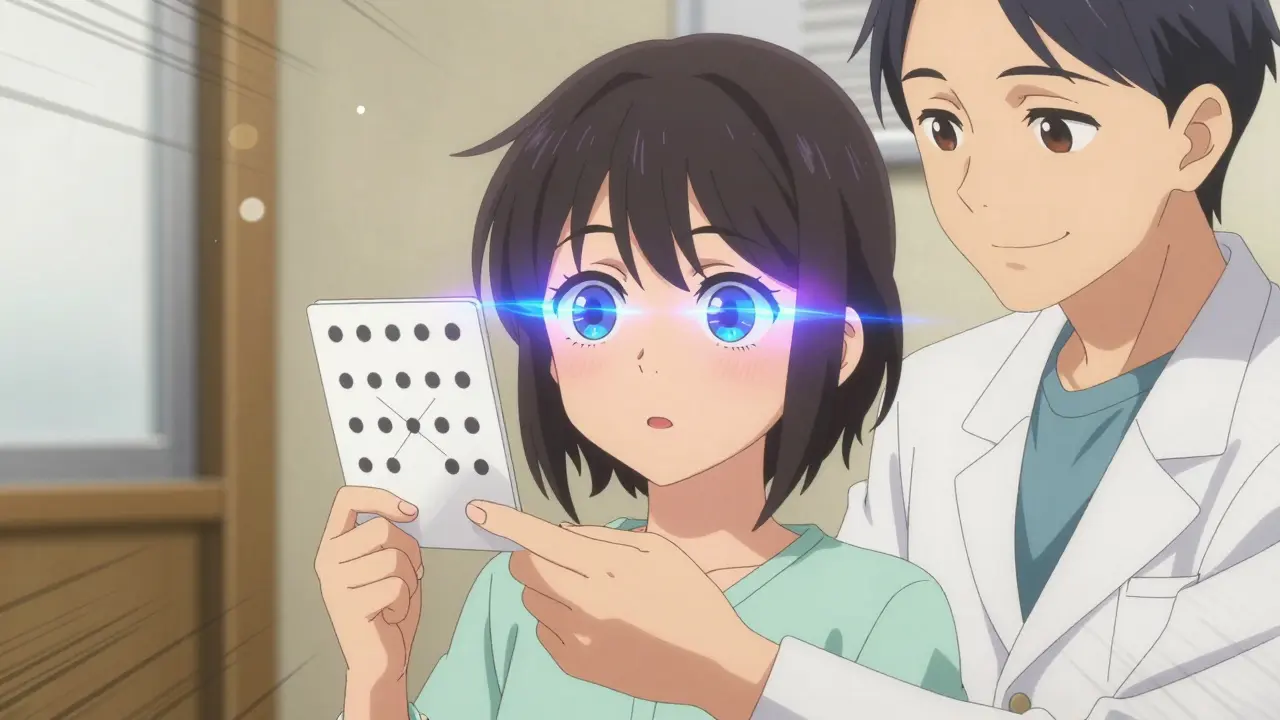
- Stereograms and convergence cards: These use overlapping dot patterns that form a 3D image when your eyes fuse correctly. It’s like a visual puzzle your brain learns to solve.
- Prism glasses: Sometimes used temporarily, base-out prisms force your eyes to work harder to converge. Base-in prisms help with reading comfort but don’t strengthen the muscles-they just mask the problem.
Modern tools like AmblyoPlay and HTS Instinctive bring these exercises to tablets and computers, offering visual feedback and progress tracking. But even these digital tools work best when paired with professional oversight. A 2023 study showed remote supervision via telehealth boosted adherence by 68%, compared to just 52% for self-guided apps.
What Doesn’t Work-and Why
There’s a lot of misinformation out there. Let’s clear up a few myths:
- Patching one eye: This is sometimes suggested for lazy eye, but it’s harmful for CI. Patching stops both eyes from working together, which is exactly what you need to fix.
- Reading glasses or blue light filters: These might help with eye fatigue from screen glare, but they don’t fix the underlying coordination problem.
- Eye exercises from YouTube: Without proper guidance, you’re likely doing them wrong. Poor form leads to no progress-or worse, bad habits.
- Prism glasses long-term: They can make reading easier in the short term, but they reduce your brain’s need to strengthen natural convergence. Think of them as a crutch, not a cure.
And while some claim vision therapy is “pseudoscience,” that’s outdated. The CITT study was peer-reviewed, randomized, and replicated. The American Optometric Association (AOA) recognizes it as evidence-based. Even the American Association for Pediatric Ophthalmology and Strabismus (AAPOS), often skeptical of behavioral therapies, admits that “a short course of treatment helps with symptoms.”
Real Results: What Patients Actually Experience
Parents of children who complete the full therapy program report life-changing improvements:
- 85% say their child can now read for longer periods without complaints
- 78% report fewer headaches
- 65% notice better school performance and focus
One parent on Reddit shared: “After 10 weeks of therapy, my 10-year-old went from skipping reading time to finishing chapter books without asking for breaks.”
Adults see similar results. Office workers who struggled with computer fatigue report being able to focus on spreadsheets or documents without constant eye strain. One 32-year-old teacher said: “I used to need a 10-minute break every 20 minutes of grading papers. After therapy, I can grade for hours without blinking.”

Cost, Insurance, and Access Challenges
Here’s the catch: vision therapy isn’t cheap. A full course typically costs $2,500 to $4,000. And insurance rarely covers it. Only 32% of private plans in the U.S. include vision therapy benefits, according to the AOA’s 2023 report. Many families pay out-of-pocket, which is a major barrier.
Another issue? Finding a qualified therapist. There are only about 1,200 COVD-certified vision therapists in the entire country. Most are concentrated in larger cities. In rural areas, access is nearly impossible without travel.
And compliance is tough. Kids get bored. Adults are busy. If you skip more than half the home exercises, your success rate drops from 82% to just 45%. That’s why modern programs now include video instructions, progress trackers, and even gamified apps to keep motivation up.
What’s Next? The Future of CI Treatment
Research is moving fast. A 2023 pilot study at SUNY College of Optometry used virtual reality to simulate convergence tasks in immersive 3D environments. Patients saw symptom relief 23% faster than with traditional methods. Companies like Vivid Vision are now building AI-driven therapy systems that adapt in real time based on how your eyes respond.
The CITT-2 study, published in early 2022, confirmed that 82% of patients kept their improvements one year after therapy ended. That’s not temporary relief-it’s lasting change.
But the biggest challenge isn’t science. It’s awareness. Nearly 80% of pediatricians still don’t screen for convergence insufficiency. Many kids are labeled as “lazy readers” or “has ADHD” when the real issue is their eyes can’t team up.
That’s changing slowly. More optometrists are training in vision therapy. More schools are partnering with vision specialists. And as digital screens become unavoidable, the need for solutions like this will only grow.
What to Do If You Suspect Convergence Insufficiency
If you or your child has persistent near-vision symptoms, don’t assume it’s just “getting old” or “too much screen time.” Here’s what to do:
- Ask your eye doctor for a convergence insufficiency screening. Don’t accept a standard vision test.
- Request the Convergence Insufficiency Symptom Survey (CISS). It’s free, quick, and tells you if symptoms match CI.
- If diagnosed, seek a COVD-certified vision therapist. Look for providers listed on the College of Optometrists in Vision Development website.
- Commit to the full 8-12 week program. No shortcuts.
- Track progress: note how long you can read without discomfort, whether headaches decrease, and if reading feels easier.
Convergence insufficiency isn’t a disease. It’s a training problem. And like any skill-playing piano, learning a language, or lifting weights-it improves with the right practice. The science is solid. The methods work. The only thing standing in your way is knowing it exists-and having the patience to follow through.





Samantha Hobbs
December 27, 2025 AT 19:13I used to think my kid was just lazy about reading until we found out it was convergence insufficiency. He’d say his eyes felt ‘weird’ but never cried or complained - just quit. After 10 weeks of therapy? He’s reading Harry Potter for fun now. No more headaches. No more avoiding homework. Just… reading. Like it’s nothing.
Why isn’t this tested in every school screening? It’s insane.
Nicole Beasley
December 27, 2025 AT 20:46OMG YES 😭 I’ve been doing pencil push-ups for months and got zero results. Then my optometrist said ‘try actual therapy’ and I was like ‘wait that’s a thing?’ Now I’m 6 weeks in and my eyes don’t feel like they’re in a tug-of-war every time I open a PDF. The VR stuff at the clinic is wild btw 🤯
sonam gupta
December 28, 2025 AT 11:24Julius Hader
December 30, 2025 AT 02:57Look I get it - this sounds like a scam if you don’t know the science. But I was a skeptic too. I spent $3,200 on this and I’m not rich. But now I can work 8 hours without needing to close my eyes for 10 minutes. I’ve got receipts from the clinic. The CITT study is real. Stop calling it pseudoscience because you don’t understand it.
And yes - it’s expensive. But so is therapy for anxiety. This is just brain-eye therapy.
Vu L
December 31, 2025 AT 08:45Wait so you’re telling me the whole thing is just eye yoga? I’ve been doing this for years - my eyes don’t work together because I’m too busy doomscrolling. Maybe just put the phone down? No magic glasses needed.
Also why does everyone act like this is new? My grandpa had this in the 80s and they just told him to blink more.
James Hilton
January 2, 2026 AT 03:21Let me get this straight - we spent 20 years telling kids to ‘just read more’ while their eyes were literally fighting each other? And now we’re shocked they hate books?
Meanwhile in 2025, a kid with CI gets labeled ADHD, gets meds, and still can’t finish a paragraph. We’re not fixing systems. We’re just drugging the symptoms. 🤦♂️
Mimi Bos
January 2, 2026 AT 20:03i just found out my 8 year old has this and i had no idea. i thought he was just distracted. now i feel so bad for making him read more when he was in pain. the therapy sounds like a lot but if it works… worth it? i dont even know where to start. any tips? 😅
Payton Daily
January 4, 2026 AT 07:07Think about it - your eyes are like two people trying to carry a couch. If one slacks off, the whole thing collapses. That’s convergence insufficiency. But here’s the deeper truth: it’s not just about eyes. It’s about focus. It’s about discipline. It’s about the soul’s inability to converge on one thing in a fractured world.
We live in a time of distraction. Your eyes are mirroring your spirit. Therapy isn’t just exercises - it’s a spiritual realignment. The brain is the temple. The eyes are the windows. And if the windows don’t align… well. You’re not seeing the truth.
Also I’ve done this therapy. It works. But only if you believe.
And yes - I’ve read all the studies. I’ve meditated on the CITT trial. I’ve stared at a pen for 30 minutes and felt my soul shift.
Kelsey Youmans
January 4, 2026 AT 19:17Thank you for this comprehensive and clinically grounded overview. The distinction between refractive error and binocular dysfunction is critically underappreciated in primary care settings. I would urge practitioners to consider integrating the CISS questionnaire into routine pediatric and adult visual assessments. The longitudinal outcomes documented in the CITT-2 study are particularly compelling and warrant broader insurance coverage. This is not a niche concern - it is a public health matter of visual literacy and cognitive accessibility.
Sydney Lee
January 5, 2026 AT 08:33How is it possible that this is still not standard in optometry curricula? The evidence has been peer-reviewed, replicated, and published in the NEI’s flagship journals. And yet - we still have parents paying out of pocket for something that should be covered like a hearing test or dental exam. This is systemic negligence. The fact that insurance companies classify this as ‘cosmetic’ or ‘alternative’ is a moral failure.
I’ve sat in 12 different clinics over three years. Every single one missed it. Until the 13th. That’s not incompetence. That’s institutional blindness.
And yes - I’m the one who finally diagnosed my own daughter after reading this exact post. Because no one else would.
oluwarotimi w alaka
January 6, 2026 AT 09:12USA spend billions on this therapy but in Nigeria we dont even have eye doctor in village. They say its eye problem but its just brain problem. Maybe its CIA trick to sell glasses? Or big pharma? I heard they make money from VR therapy. Why not just give kids more water? Water fix everything. Also why no study from Africa? Maybe its not real? Or maybe its rich people problem?