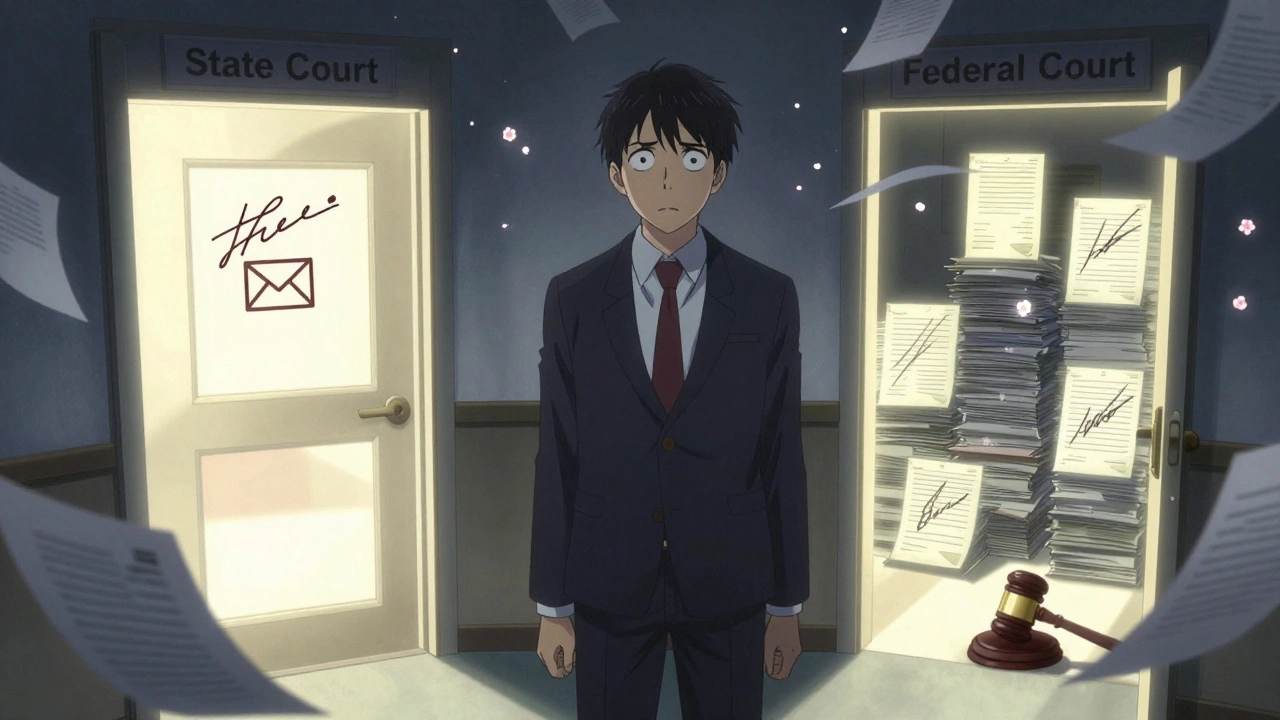
When you switch lawyers in the middle of a case, it’s not just a personal decision-it’s a legal procedure. And if you’re not careful, the rules you follow in state court could get you into serious trouble in federal court. The difference isn’t subtle. It’s the kind of mistake that gets your motion thrown out, delays your case, or even costs you your client’s trust.
Why Substitution Rules Even Matter
Every lawyer knows: clients change their minds. Sometimes they lose confidence. Sometimes they find someone cheaper. Sometimes they just want a fresh perspective. That’s fine. But in court, changing lawyers isn’t as simple as signing a new contract. There are rules. And those rules are completely different depending on whether you’re in a state court or a federal court.Here’s the bottom line: federal courts demand paperwork, approval, and justification. State courts? Often, they just want a signed form and a quick email. That 30-point gap in approval rates for last-minute substitutions isn’t a typo-it’s a trap waiting for attorneys who assume state rules apply everywhere.
Federal Rules: The Paperwork Maze
Federal courts operate under the Federal Rules of Civil Procedure, last updated in December 2023. Rule 83 is the key player here. It doesn’t just ask for a substitution request-it requires three signatures: the client, the outgoing lawyer, and the new lawyer. Even if you’re switching to another lawyer in the same firm, you still need court approval.It gets more complicated in specific districts. In the Eastern District of New York, you can’t just file a motion-you need a letter motion addressed to a magistrate judge. In the Central District of California, your signature must be electronic. In the District of Columbia, you need a wet-ink signature. One mistake, and your motion gets stricken.
Federal courts also demand justification. Why are you switching? Is the new attorney qualified? In federal tax court, you must prove the substitute lawyer is even authorized to practice before the IRS. No guesswork. No shortcuts. The Second Circuit rejected 31% of substitution motions filed within 30 days of trial in 2023. That’s not a warning-it’s a rule.
State Rules: A Patchwork of Freedom
Now flip the script. In 32 states-including California, Texas, and New York-you can swap lawyers without ever setting foot in court. Florida’s Supreme Court Rule 4-1.16(c) says the client has an absolute right to choose counsel. All you need is a signed form between the lawyers. No judge. No motion. No waiting.Virginia lets attorneys substitute without any court appearance at all. New Jersey requires only seven days’ notice. California approved 89% of substitution motions filed just weeks before trial in 2024. Compare that to federal courts, where timing is scrutinized like a tax audit.
But here’s the catch: within the same state, rules can vary wildly. In Texas, Harris County requires electronic filing. Brewster County still accepts paper forms. In New York, state courts let you email confirmation. Federal courts in New York demand a formal motion. If you’re practicing in both systems, you’re juggling two rulebooks.

The Real Danger: Assuming Rules Are the Same
This isn’t theoretical. In 2023, 17% of legal malpractice claims involved substitution errors. And 68% of those came from attorneys who applied state procedures in federal court.Attorney Mark Reynolds from Chicago filed a standard Illinois substitution form in federal court-thinking it would be enough. His motion was struck. His client’s case was delayed. He lost $8,500 in wasted fees. He wasn’t negligent. He was misinformed.
Reddit threads are full of similar stories. One attorney in New York called the federal court’s requirement for magistrate judge approval on same-firm substitutions “absurd.” But the court didn’t care. The rule was clear. And federal law wins.
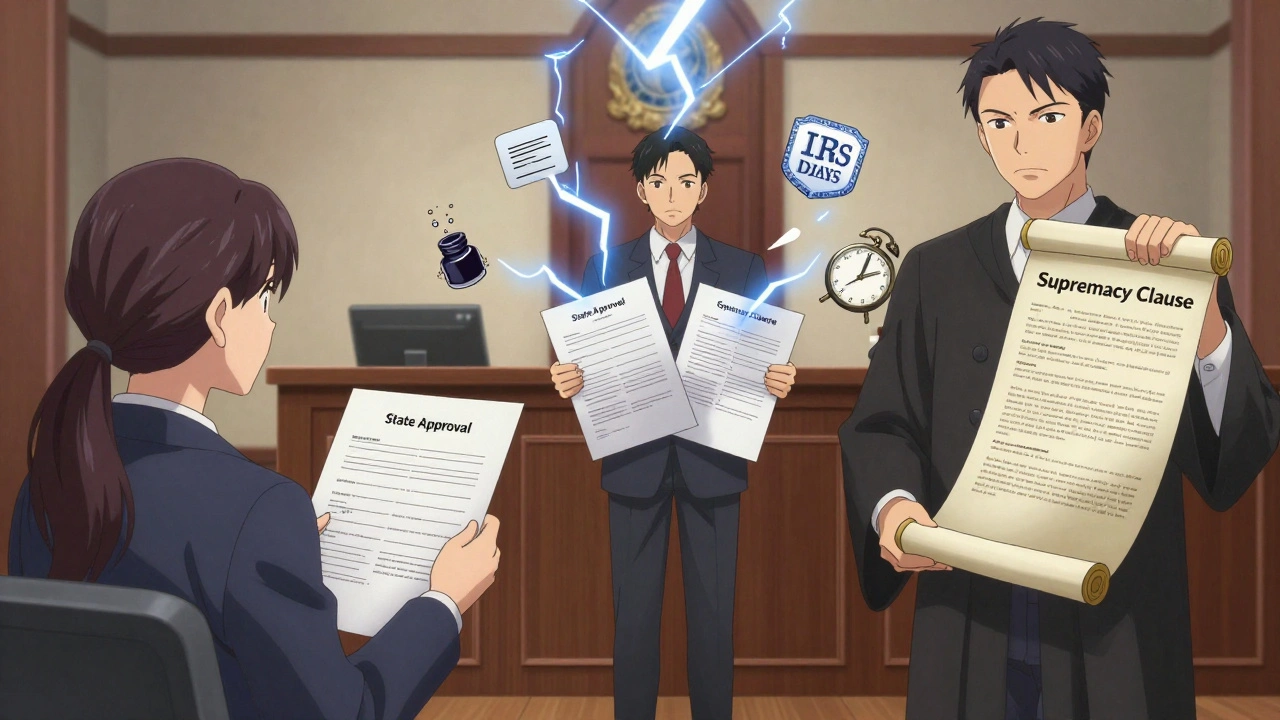
That’s because of the Supremacy Clause. Since McCulloch v. Maryland in 1819, federal law has always taken precedence over conflicting state law. So even if your state lets you swap lawyers with a quick email, federal court won’t accept it. You still need the motion. You still need the signatures. You still need the approval.
What You Need to Do Right Now
If you’re practicing in both state and federal courts, here’s your action plan:- Keep separate templates: one for federal, one for state. Don’t reuse them.
- Check local rules. Every federal district has its own variations. The Central District of California? Electronic only. District of Columbia? Wet ink. No exceptions.
- File early. Even if your state allows last-minute changes, federal courts don’t. Aim for at least 45 days before trial.
- Include detailed justification in federal filings. Explain why the new attorney is qualified. Mention experience in similar cases.
- Verify jurisdictional qualifications. If it’s a tax case, confirm the new lawyer is admitted to practice before the IRS.
Law firms that use dual-template systems reduced substitution errors by 47% in 2023. That’s not magic. That’s discipline.
What’s Changing in 2025 and Beyond
The system is under pressure. More attorneys now practice in both state and federal courts-28% in 2025, up from 22% in 2020. The legal tech industry is responding. Clio’s Jurisdictional Compliance Module, launched in late 2024, cut substitution errors by 39% in a Stanford study.The Federal Rules Advisory Committee is considering changes for 2026: standardized electronic filing, clearer emergency substitution rules. The Uniform Law Commission is drafting the Interjurisdictional Legal Practice Act, expected in December 2025. It could finally bring consistency.
But until then, the gap remains. Federal courts prioritize control. State courts prioritize client choice. And if you’re caught in the middle, you’re the one who pays.
What Happens If You Get It Wrong?
Your motion gets denied. Your client’s case stalls. The judge loses patience. Your reputation takes a hit. And if your client sues you for malpractice? You’re looking at a claim that’s 23% more likely now than in 2022.There’s no second chance. Once a substitution is denied in federal court, you can’t just refile the same form. You have to fix the error, refile, and wait again. That’s weeks lost. That’s money gone. That’s trust broken.
It’s not about being perfect. It’s about being prepared. The rules aren’t designed to frustrate you. They’re designed to protect the court’s ability to manage its docket. But if you don’t know them, you’re not protecting your client-you’re endangering them.
Can I use the same substitution form for state and federal court?
No. State court forms often lack the required signatures, justifications, and procedural details federal courts demand. Using a state form in federal court will get your motion rejected. Always use jurisdiction-specific templates.
What if I need to substitute counsel right before trial?
In federal court, motions filed within 30 days of trial have a high chance of being denied-31% were rejected in the Second Circuit in 2023. You must show an emergency, like the original attorney becoming incapacitated. In state courts, you’re more likely to get approval, but federal rules still apply in federal court.
Do I need court approval to switch to another lawyer in my own firm?
In federal court, yes. Even same-firm substitutions require a formal motion and court approval under Rule 83. In most states, no approval is needed-just a signed agreement between the lawyers. Don’t assume state rules apply in federal court.
What happens if I file a substitution motion without the new attorney’s qualifications?
The court will likely deny it. In specialized courts like federal tax court, Rule 83.12 requires proof the new attorney is authorized to practice before the IRS. Without that, your motion won’t even be reviewed.
Can I rely on my state bar’s guidance for federal court procedures?
No. State bar associations don’t control federal court rules. The American Bar Association’s Formal Opinion 502 (March 2024) states that failing to follow federal substitution rules is professional misconduct-even if your state allows more flexibility.






Joe Lam
December 4, 2025 AT 18:10Let’s be real-this isn’t about procedure, it’s about control. Federal courts act like they’re running a medieval guild, demanding signatures like they’re guarding the Holy Grail. Meanwhile, state courts treat lawyers like adults. The real issue? Federal judges are insecure. They need to feel like they’re in charge, even when it’s pointless.
And don’t get me started on ‘wet-ink signatures’ in 2025. We’re not signing land deeds here. It’s performative bureaucracy. The system’s broken, and no amount of Clio modules will fix that.
They don’t want efficiency. They want obedience. And the worst part? Young attorneys buy into it. They think following every absurd rule makes them ‘professional.’ It makes them sheep.
I’ve seen associates cry over a missing magistrate letter motion. Meanwhile, the client’s case is rotting on the vine. That’s not justice. That’s institutional gaslighting.
Jenny Rogers
December 6, 2025 AT 05:19It is both a moral and jurisprudential failure to conflate procedural convenience with legal integrity. The Supremacy Clause is not a suggestion-it is the foundational architecture of our constitutional republic. To treat federal rules as optional is not merely negligence; it is a form of civic disrespect.
State courts may operate under the illusion of autonomy, but they derive their authority from the same federal framework that binds all courts. To assume that flexibility equals legitimacy is to misunderstand the very nature of law as a disciplined system, not a buffet of preferences.
Attorneys who cut corners do not serve their clients-they betray the rule of law. The 17% malpractice statistic is not a coincidence. It is the inevitable consequence of moral laziness dressed up as pragmatism.
There is no such thing as ‘too much paperwork’ when the integrity of the court is at stake. The notion that efficiency should trump fidelity to procedure is a hallmark of the decline of professional ethics in the legal field.
Rachel Bonaparte
December 6, 2025 AT 14:39Okay but have you ever wondered why federal courts are so rigid? It’s not about ‘rules’-it’s about control. The same people who demand wet-ink signatures and magistrate letters are the ones who quietly let corporate lawyers slide on discovery violations.
Think about it: why does a solo practitioner need five signatures to switch lawyers, but BigLaw can file a motion at 11:59 PM the night before trial and get it approved because they ‘have relationships’?
I’ve seen it. I’ve seen the same judge who denied a pro se litigant for missing a form grant an Akin Gump partner a 24-hour extension because he ‘has a busy calendar.’
This isn’t about procedure. It’s about power. The system is rigged to favor those who play the game well, not those who follow the rules.
And don’t tell me about ‘professional standards’-the same bar associations that scream about substitution forms are the ones who let partners sleep through CLEs while billing $1,000/hour.
They want you to think it’s about paperwork. It’s not. It’s about who you know, who you are, and whether you’re allowed to be in the room.
They’re not protecting the docket. They’re protecting their own privilege.
And Clio’s ‘compliance module’? That’s just another way to monetize your fear. They’re selling you a band-aid for a severed artery.
Scott van Haastrecht
December 6, 2025 AT 18:53Let me guess-you’re the type who thinks ‘state rules are easier’ so you just wing it in federal court, then blame the system when you get slapped down. You’re not a lawyer. You’re a liability.
31% rejection rate in the Second Circuit? That’s not a warning. That’s a wake-up call. And you still don’t get it, do you?
Mark Reynolds lost $8,500? Good. He deserved it. You don’t get to treat federal court like a suggestion box. You show up prepared or you get buried.
I’ve seen attorneys cry because they used a state form. I’ve seen judges roll their eyes and say ‘this is why I hate new associates.’
There’s no excuse. No ‘I didn’t know.’ You have Westlaw. You have PACER. You have five minutes to Google ‘Eastern District substitution requirements.’
Stop acting like this is a mystery. It’s not. It’s your job. Fail at your job, and you deserve to lose.
Chase Brittingham
December 8, 2025 AT 01:50Man, I’ve been on both sides of this. I used to be the guy who thought ‘it’s just a form’-until my client’s motion got denied and we lost a critical evidentiary window.
After that, I made a checklist. Printed it. Laminated it. Put it on my desk.
Now I have two folders: State and Federal. One click, one template. No more guessing.
It’s not glamorous. It’s not exciting. But it’s what keeps your license and your client’s case alive.
And yeah, the system’s messy. But the fix isn’t complaining-it’s doing the work. I’ve helped three junior associates avoid disasters just by sharing my templates.
You don’t need to hate the rules. You just need to know them.
And if you’re too busy to learn? Maybe you’re in the wrong line of work.
michael booth
December 10, 2025 AT 01:42Discipline is the silent guardian of legal integrity.
When an attorney substitutes counsel without adhering to jurisdictional mandates, they do not merely violate a rule-they erode the trust that underpins the entire judicial system.
It is not enough to be technically correct. One must be procedurally impeccable.
The 47% reduction in errors among firms using dual-template systems is not anecdotal-it is empirical evidence of the power of structure.
Let us not mistake efficiency for excellence.
Let us not confuse convenience with competence.
There is no substitute for diligence.
There is no shortcut to professionalism.
Prepare. Verify. Submit.
That is the work.
That is the standard.
That is the law.
Heidi Thomas
December 11, 2025 AT 03:28Federal courts are just trying to keep the chaos from swallowing the whole system. You think it’s overkill? Try being a clerk who gets 30 last-minute substitution motions on a Friday before a trial. Half of them are missing one signature. Half of those are from attorneys who didn’t even check local rules.
It’s not about control. It’s about survival.
And if you’re too lazy to learn two sets of rules, don’t blame the system. Blame yourself.
Also-wet-ink? Fine. Electronic? Fine. Just don’t send a scanned signature from your phone like it’s a Snapchat.
Some of us actually care about the outcome, not just the convenience.
Alex Piddington
December 12, 2025 AT 07:57To the new attorneys reading this: you are not behind. You are not behind at all.
Learning jurisdictional rules is like learning a new dialect-it takes time, and it’s messy at first.
I started out using state forms in federal court too. Got slapped down hard. It hurt. But I didn’t quit.
I built a spreadsheet. I bookmarked every district’s local rules. I asked senior partners for their templates.
Now I mentor three associates every year. I tell them: ‘You don’t need to know everything. You just need to know where to look.’
And if you’re reading this and thinking ‘I don’t have time’-you’re not busy. You’re misprioritizing.
This isn’t about perfection. It’s about progress.
One checklist. One hour. One less disaster.
You’ve got this.
And if you need help? I’ve got your back.