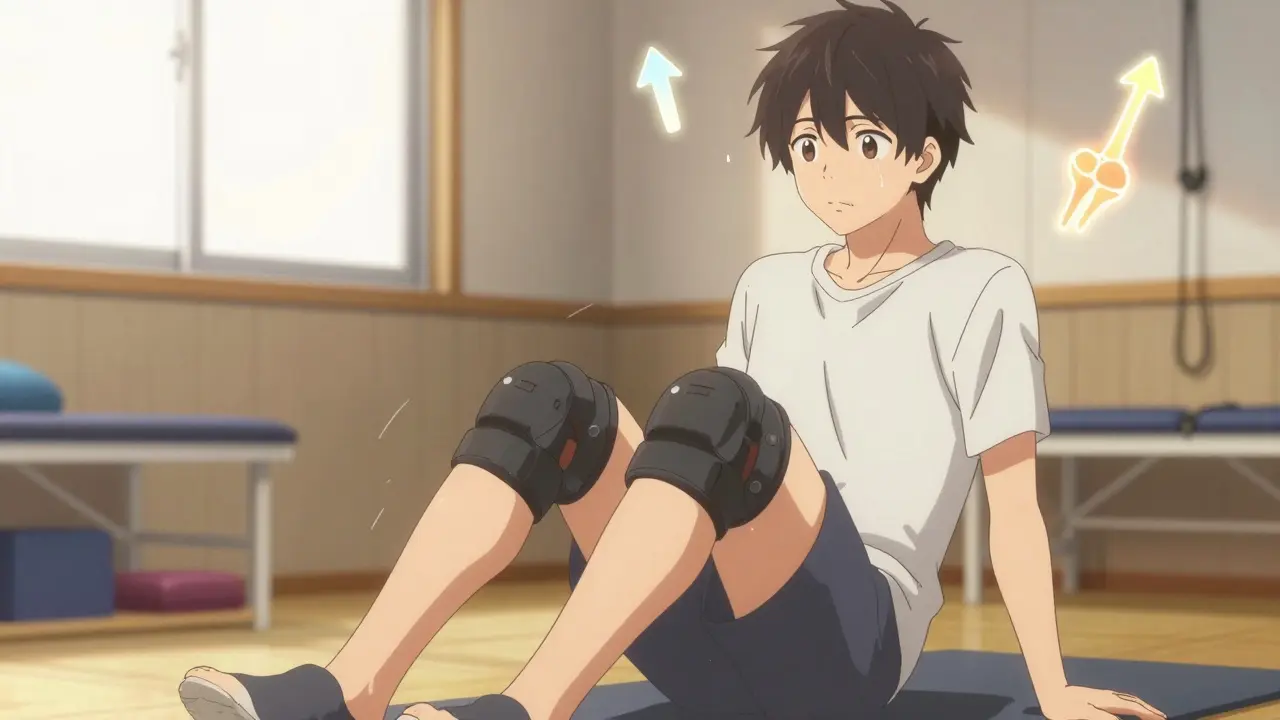
When your knees ache getting out of bed, or your hips stiffen up walking up stairs, it’s not just aging-it’s a joint disorder. And the most effective, science-backed way to fight back isn’t another pill or injection. It’s physical therapy. Not as a last resort. Not as a supplement. But as the core treatment that can actually change the course of your condition.
For osteoarthritis, rheumatoid arthritis, hip or knee pain, and even sacroiliac joint dysfunction, physical therapy isn’t about stretching lightly or doing a few squats. It’s a precise, personalized program built on decades of clinical research. Studies show that structured physical therapy reduces pain by nearly 38% and improves daily function by almost 30% compared to doing nothing or just taking painkillers. And here’s the kicker: for many people with mild-to-moderate hip osteoarthritis, physical therapy works just as well as surgery-at least for the first few years.
Why Movement Is Medicine, Not a Bonus
For decades, doctors treated joint disorders like broken machines: fix them with drugs or replace them with metal. But now we know joints aren’t just worn-out parts. They’re living tissue that responds to movement. When you move a stiff knee or strengthen weak hip muscles, you’re not just easing pain-you’re feeding cartilage, reducing inflammation, and improving joint lubrication.
The American College of Rheumatology updated its guidelines in 2021 to say this clearly: exercise is disease-modifying for rheumatoid arthritis. That means it doesn’t just mask symptoms-it slows down joint damage. Patients who stick to their exercise plan show 23% slower progression of joint destruction on X-rays. That’s not a minor benefit. That’s a game-changer.
And it’s not just for arthritis. For sacroiliac joint pain, physical therapy combined with targeted manual therapy reduces pain by 68% after a year. Compare that to NSAIDs alone, which only help 32% of people. The difference isn’t subtle-it’s dramatic.
Range of Motion: How Much and How Often
Stiffness is the first thing people notice. You can’t fully bend your knee. You can’t reach behind your back. That’s not just discomfort-it’s loss of function. Range of motion (ROM) exercises aren’t optional. They’re mandatory.
For knee osteoarthritis, the standard protocol is 3 sets of 10 to 15 repetitions of terminal knee extension-fully straightening the knee-five days a week. The resistance? Just enough to feel the muscle working, but not enough to push pain past a 3 out of 10. Too much pain, and you’re damaging tissue. Too little, and you’re wasting time.
It’s not about how far you can stretch. It’s about how consistently you move. A 2023 study found that patients who did their ROM exercises five days a week improved joint flexibility by 27% in just six weeks. Those who skipped two or more days saw almost no progress.
For shoulders, hips, or wrists, the same rule applies: daily movement, controlled and pain-free. Aquatic therapy works wonders here. Water at 91-97°F reduces joint load by up to 80%, letting you move more freely. Three 30-45 minute sessions a week can restore mobility faster than land-based therapy alone.
Strengthening: The Real Game Changer
Weak muscles don’t cause joint disorders-but they make them worse. When your quadriceps are weak, your knee bears more pressure. When your glutes are inactive, your hip joint grinds. Strengthening isn’t about lifting heavy. It’s about lifting smart.
For hip osteoarthritis, the 2025 JOSPT guidelines recommend hip abductor exercises with 2.5-5.0 kg resistance. Three sets of 15 reps, three times a week. That’s it. Not 100 squats. Not leg presses with 200 pounds. Just controlled, slow movements that target the right muscles.
For rheumatoid arthritis, resistance training at 40-60% of your one-rep max twice a week reduces joint swelling and improves grip strength. Patients report being able to open jars again, carry groceries, and hold their grandkids without pain.
And here’s what most people don’t realize: isometric exercises-where you contract the muscle without moving the joint-are critical in the early stages. If your knee is too swollen to bend, you can still strengthen your quads by pushing your knee down into a towel roll. No movement. Just tension. That builds strength without aggravating pain.

When Physical Therapy Works Best-and When It Doesn’t
Physical therapy isn’t magic. It has limits. If your X-ray shows more than 50% joint space narrowing, exercise alone won’t restore function. That’s when surgery becomes the better option. But even then, physical therapy still matters. Patients who do pre-surgery rehab (called prehab) have 31% fewer complications after joint replacement and leave the hospital 1.8 days sooner.
On the flip side, physical therapy can delay surgery for years. One study found that patients with mild-to-moderate hip OA who stuck with therapy postponed total hip replacement by an average of 2.7 years. That’s thousands of dollars saved and years of natural joint function preserved.
And cost-wise, it’s a no-brainer. Medicare data shows patients who get physical therapy before knee replacement have 22% lower total episode costs. For knee osteoarthritis, physical therapy saves $7,842 per quality-adjusted life year compared to cortisone shots. That’s not just personal savings-it’s systemic change.
What Makes Therapy Actually Work
Not all physical therapy is equal. A 2024 study found 63% variation in exercise prescriptions for identical knee OA cases across different clinics. That’s chaos. The difference between success and failure comes down to three things:
- Personalization-A generic “knee exercise” handout won’t cut it. Your program must match your pain level, strength, mobility, and goals.
- Progression-You can’t do the same 10 reps with the same weight for six weeks. Resistance must increase by 0.5-1.0 kg weekly. Reps must increase as strength improves.
- Adherence-You need to do at least 70% of your prescribed sessions. If you skip more than three days a week, results vanish.
Physical therapists trained in musculoskeletal care complete 120 hours of specialized assessment training and 80 hours in exercise prescription. They use tools like the HOOS (Hip Disability and Osteoarthritis Outcome Score) or KOOS to track progress. A 10-point improvement on these scales is clinically meaningful. Not “I feel better.” But measurable, documented change.
Real People, Real Results
On Healthgrades, physical therapy for joint disorders has a 4.2 out of 5 rating from nearly 15,000 reviews. The most common win? Being able to climb stairs without pain. That’s not a luxury-it’s independence.
One Reddit user, 62, with bilateral knee OA, said: “I started with terminal knee extensions using 2.5kg ankle weights. After six weeks, I could stand up from the couch without using my hands. That’s when I knew this worked.”
Another, 58, with hip OA, shared: “I was told I’d need a replacement in two years. After 10 weeks of therapy, my doctor said, ‘Let’s wait.’ I’ve been pain-free for 18 months.”
But it’s not all success stories. A third of patients quit because of transportation issues. Rural patients are 2.4 times more likely to drop out. Insurance limits are another roadblock-58% of negative reviews cite session caps. That’s why telehealth is growing fast. New Medicare billing codes as of January 2025 now cover remote therapy using wearable sensors that track movement accuracy. You can now do your exercises at home, with your therapist watching your form on video.
What’s Next for Physical Therapy
The field is getting smarter. In 2025, new guidelines use machine learning to predict who will respond best to which exercises-based on your BMI, HOOS score, and X-ray severity. Accuracy? 83%. That means no more guessing. You get the right program the first time.
Neuromuscular electrical stimulation (NMES) is now being combined with exercise. One 2024 study showed 41% greater strength gains in knee OA patients using NMES alongside traditional therapy. It’s not a magic wand-but it’s a powerful tool.
Starting in 2026, Medicare will expand coverage for maintenance therapy for chronic joint conditions. That means you won’t have to stop after 12 visits. You can keep going, as long as you’re making progress.
And the numbers behind it are staggering. If every eligible patient with joint pain got evidence-based physical therapy first, we could prevent 185,000 joint replacements a year. That’s $9.2 billion saved. Not just for insurers-for people.
What to Do Now
If you have joint pain that’s limiting your life, don’t wait. Don’t assume it’s just “getting older.”
Ask your doctor for a referral to a physical therapist who specializes in orthopedics. Look for one who uses outcome measures like HOOS or KOOS-not just “how do you feel?”
Start with range of motion. Daily. Even if it’s just 5 minutes. Then add strengthening. Start light. Stay consistent. Track your progress. Can you stand up from a chair without using your hands? Can you walk 10 minutes without stopping? Those are your real goals.
Physical therapy isn’t a quick fix. It’s a long-term investment in your body. And the data doesn’t lie: if you stick with it, you’ll move better, feel stronger, and live freer.





Matthew Ingersoll
December 26, 2025 AT 22:18Physical therapy saved my knees after two years of limping around like a broken robot. No pills, no shots-just consistent movement. I did the terminal knee extensions five days a week, even when I didn’t feel like it. Six weeks in, I stood up from the couch without using my hands for the first time in years. No hype. Just facts.
carissa projo
December 27, 2025 AT 21:25It’s funny how we’ve been taught to see pain as something to suppress, not as a signal to move differently. Joints aren’t machines-they’re living ecosystems. When you move with intention, you’re not just rehabbing-you’re reawakening. The body remembers how to heal when you give it the right language, the right rhythm, the right patience. This isn’t exercise as punishment. It’s medicine as communion.
david jackson
December 29, 2025 AT 20:19Okay, let’s just pause for a second and appreciate how wild it is that we’re still arguing about whether movement is medicine. We’ve got peer-reviewed studies showing PT slows joint destruction by 23% on X-rays, yet people still think the answer is a cortisone shot and a prayer. And don’t even get me started on the insurance companies who cap you at 12 visits like you’re buying a gym membership instead of preventing a lifetime of disability. This isn’t just healthcare-it’s a systemic betrayal of aging people who just want to walk to the mailbox without crying. And now they’re adding wearable sensors and machine learning? Finally. Took long enough.
Jody Kennedy
December 30, 2025 AT 13:27I started PT after my hip started screaming every time I got out of bed. I thought I’d hate it-but it was the first time in years I felt like I was doing something active for myself, not just reacting to pain. My therapist didn’t just give me exercises-she asked me what I wanted to do again. Hiking. Playing with my niece. Dancing in the kitchen. That’s when it clicked. This isn’t about fixing a joint-it’s about reclaiming joy. I’m 6 months in. I just took a 3-mile walk. No pain. Just pride.
christian ebongue
December 31, 2025 AT 18:23PT works. But only if you don’t quit after 3 days. Also, most clinics are just glorified yoga studios with a physical therapist sticker. Find one who uses KOOS/HOOS. Otherwise, you’re wasting your time. And no, doing 10 squats on a ball doesn’t count as ‘personalized.’
jesse chen
January 1, 2026 AT 06:17Just wanted to say-this post made me cry a little. Not because it’s sad, but because it’s so true. I’ve been through three different PT programs, and only one actually tracked progress with real numbers. The rest? ‘How do you feel?’ ‘Better!’ ‘Cool, next week!’ That’s not therapy. That’s small talk with a clipboard. The ones who use HOOS, who adjust resistance weekly, who care about the 10-point improvement-that’s where the magic happens. Thank you for saying this out loud.
Joanne Smith
January 1, 2026 AT 15:24My PT told me isometrics were ‘cheating’ until I showed her the 2023 study. Now she uses them with every patient with acute swelling. Funny how the most effective tools are the ones that look like nothing. Pushing your knee into a towel roll? Sounds ridiculous. Works like a charm. Also, water therapy is underrated. I did it in a hotel pool while traveling-no equipment, no judgment, just movement. Life hack.
Prasanthi Kontemukkala
January 2, 2026 AT 13:56In India, access to PT is still a luxury. Many people think joint pain means ‘rest more.’ But I’ve seen friends who started gentle daily movement-just 10 minutes-and now they walk to the market without help. It’s not about fancy gear. It’s about consistency. Even a slow, careful step counts. I wish more clinics here understood that. Maybe one day.
Alex Ragen
January 4, 2026 AT 02:37Of course physical therapy works-when it’s delivered by a licensed professional with a PhD in biomechanics, who’s read every paper since 1998, and has access to a $50,000 motion-capture lab. But let’s not pretend the average clinic-staffed by overworked therapists billing 10 patients an hour-is giving you anything but a glorified YouTube tutorial. The data? Beautiful. The reality? A broken system masquerading as science.
Lori Anne Franklin
January 4, 2026 AT 14:11i just started and honestly thought i was gonna hate it but my therapist is so chill and we laugh while i do the dumb exercises. last week i picked up my dog without my back screaming. i didn’t even think i could do that anymore. also i misspelled ‘physiotherapy’ in my notes and she didn’t even care. that’s the good kind of care.
Bryan Woods
January 5, 2026 AT 10:46The data presented here is compelling and aligns with current clinical guidelines. However, adherence remains the most significant variable in outcomes. The psychological and logistical barriers to consistent participation are underappreciated in public discourse. Further research into behavioral reinforcement strategies is warranted.
Ryan Cheng
January 5, 2026 AT 23:43For anyone thinking about starting: don’t wait for the pain to be ‘bad enough.’ Start when it’s just annoying. That’s the sweet spot. I waited too long. My first session felt like I was learning to walk again. But after three weeks? I could carry groceries without wincing. And the best part? My therapist didn’t yell at me for skipping a day. She just asked why. That’s the difference between a coach and a drill sergeant.
wendy parrales fong
January 7, 2026 AT 13:35I used to think PT was for people who got hurt playing sports. Then my mom started it for her knees. She didn’t lift weights. She didn’t run. She just moved-every day, even if it was just standing up and sitting down ten times. Now she dances with her grandkids. No surgery. No pills. Just slow, steady, stubborn movement. I’m doing it now too. It’s not magic. It’s just not giving up.