Codeine & SSRI Interaction Checker
Step 1: Select Your Medications
Step 2: Analysis Result
Select your medications and click "Check Interaction Risk" to see if your pain medication might be ineffective.
Explanation:
Result details will appear here.
Recommendation:
Medical advice placeholder.
Imagine taking a painkiller that should work perfectly for your post-surgery ache, only to feel absolutely nothing. You take another dose. Still nothing. It feels like the medicine is a placebo, but it isn't. The problem might not be your tolerance or the dosage-it could be the antidepressant you’ve been taking for years. If you are on fluoxetine (Prozac) or paroxetine (Paxil), your body may have stopped converting codeine into its active pain-relieving form.
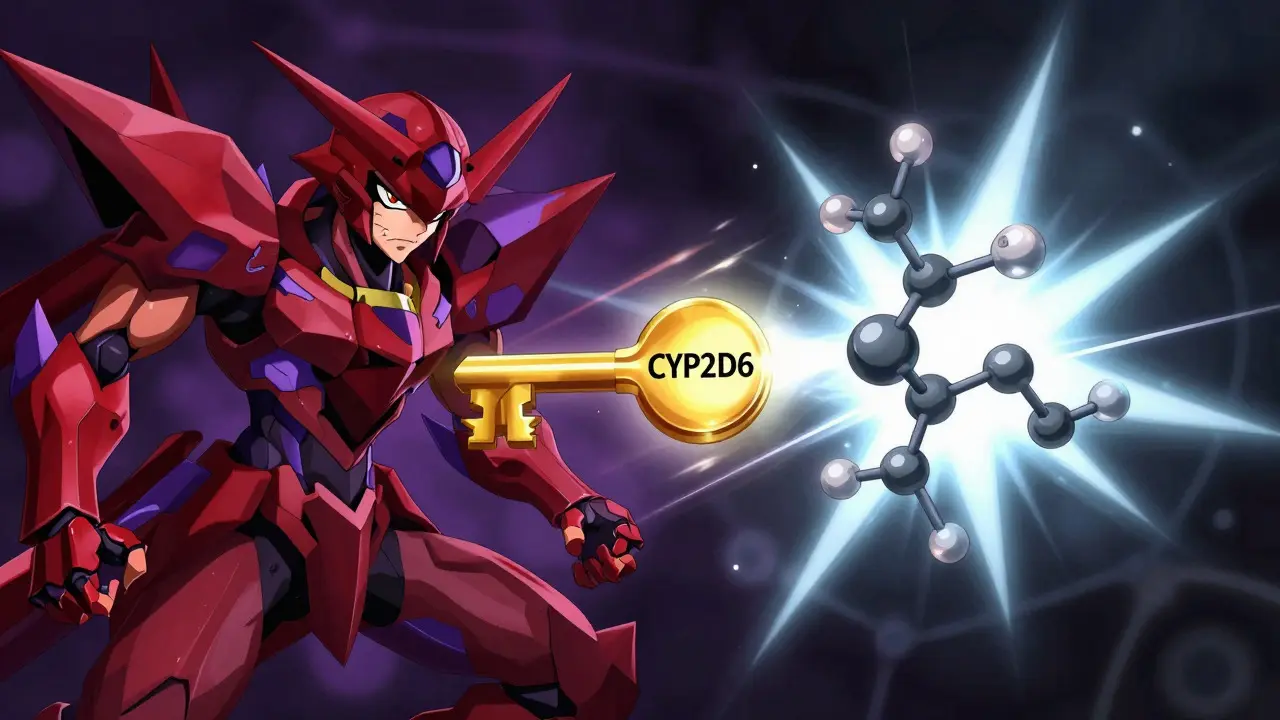
This is not a rare side effect; it is a well-documented pharmacological roadblock known as a drug-drug interaction. Specifically, these selective serotonin reuptake inhibitors (SSRIs) block an enzyme called CYP2D6, which is the key that unlocks codeine’s pain-relieving power. When that key is jammed, the lock doesn’t open, and the pain remains.
The Mechanism: How Codeine Actually Works
To understand why this interaction happens, we first need to look at what codeine actually is. Unlike morphine or oxycodone, which are active drugs in their own right, codeine is a prodrug. This means it is biologically inactive until your liver processes it. Think of it like a raw ingredient that needs to be cooked before it becomes edible.
The "cooking" process involves the enzyme CYP2D6, part of the cytochrome P450 family found in your liver. This enzyme performs a specific chemical reaction called O-demethylation, stripping away a molecule from codeine to transform it into morphine. Morphine is the actual compound that binds to receptors in your brain and spinal cord to block pain signals. Without this conversion, codeine provides little to no relief for moderate to severe pain.
Research from the 1970s established that only about 5-10% of a standard codeine dose converts to morphine via this pathway. For most people, this small amount is enough to dull the pain. But if something interferes with the CYP2D6 enzyme, that conversion rate drops precipitously, leaving you with just the inactive prodrug circulating in your system.
The Blockers: Fluoxetine and Paroxetine
Enter fluoxetine and paroxetine. These are among the most commonly prescribed SSRIs for depression and anxiety. While they are highly effective for mental health, they have a significant secondary effect: they are potent inhibitors of CYP2D6. In pharmacological terms, "inhibition" means they bind to the enzyme and prevent it from doing its job.
Paroxetine is particularly aggressive in this regard. Studies show it has a Ki value (a measure of inhibitor potency) of approximately 0.14 µM, making it one of the strongest clinical CYP2D6 inhibitors available. Fluoxetine is slightly less potent but still very strong, with a Ki value around 0.2 µM. To put this in perspective, other common antidepressants like citalopram or escitalopram have minimal impact on this enzyme, with Ki values greater than 50 µM.
When you take paroxetine or fluoxetine alongside codeine, these drugs competitively inhibit the CYP2D6 enzyme. They essentially sit in the driver's seat, preventing the enzyme from processing codeine. A landmark study by Gasche et al. in 2004 demonstrated that taking paroxetine reduced the amount of morphine produced from codeine by 78%. In many cases, this turns a person who normally metabolizes drugs efficiently into a "functional poor metabolizer," meaning their body acts as if it lacks the genetic ability to process the drug entirely.
| Medication | CYP2D6 Inhibition Strength | Impact on Codeine Efficacy | Ki Value (µM) |
|---|---|---|---|
| Paroxetine | Strong | Severe Reduction / Loss | 0.14 |
| Fluoxetine | Strong | Significant Reduction | 0.20 |
| Sertraline | Moderate | Mild to Moderate Reduction | 2.5 |
| Citalopram | Weak/None | No Significant Impact | >50 |
| Escitalopram | Weak/None | No Significant Impact | >50 |
Clinical Consequences: The Pain Gap
The real-world consequence of this biochemical blockade is simple: inadequate pain control. This isn't just a theoretical risk; it is a frequent occurrence in clinical settings. A 2020 survey of over 1,200 pain management specialists revealed that nearly 80% had encountered patients whose pain was not controlled due to this specific interaction.
Consider the case of a patient recovering from surgery who is chronically managed on paroxetine for anxiety. Their surgeon prescribes codeine for post-operative pain. The patient takes the medication as directed but reports zero relief. Frustrated, they might double the dose, risking side effects like nausea and constipation without gaining any additional pain relief, because the bottleneck remains the blocked enzyme, not the lack of drug quantity.
Data from the FDA Adverse Event Reporting System (FAERS) supports this experience. Between 2010 and 2020, there were hundreds of reports linking "inadequate analgesia" specifically to combinations of codeine and paroxetine. The reporting odds ratio was significantly higher than expected, indicating a clear pattern of treatment failure.
Solutions and Alternatives
If you are on fluoxetine or paroxetine and require pain management, you have options. The goal is to bypass the CYP2D6 pathway entirely. Fortunately, not all opioids rely on this enzyme.
- Oxycodone: This opioid is metabolized primarily by a different enzyme, CYP3A4. It does not require conversion by CYP2D6 to become active, so its efficacy is largely unaffected by SSRIs like paroxetine or fluoxetine.
- Morphine: Since morphine is already the active drug, it skips the conversion step entirely. It can be used directly, though dosing must be carefully managed by a physician.
- Hydromorphone: Similar to morphine, this is an active opioid that does not depend on CYP2D6 for activation.
- Switching Antidepressants: If possible, a psychiatrist might switch a patient to an SSRI with minimal CYP2D6 inhibition, such as citalopram or escitalopram, especially if long-term opioid use is anticipated.
The Clinical Pharmacogenetics Implementation Consortium (CPIC) explicitly recommends avoiding codeine in patients taking strong CYP2D6 inhibitors. Their guidelines, updated recently, emphasize that this combination often leads to therapeutic failure.

Genetic Factors and Individual Variability
While drug interactions are the primary focus here, genetics also play a role. People are born with different variations of the CYP2D6 gene. Some are "poor metabolizers" naturally, while others are "ultrarapid metabolizers." However, when you introduce a strong inhibitor like paroxetine, it overrides your natural genetics. Even if you are genetically capable of processing codeine efficiently, the drug inhibitor creates a "pharmacological poor metabolizer" state. This means the interaction affects almost everyone taking these specific combinations, regardless of their baseline genetic profile.
This complexity is why pharmacists and doctors are increasingly screening for these interactions before prescribing. Tools like the University of Utah’s Drug Interaction Checker rate the codeine-paroxetine combination as "Severe - Use Alternative," highlighting the importance of proactive management.
Practical Steps for Patients
If you are currently taking codeine and notice it isn't working, do not simply increase the dose on your own. Overdosing on codeine can lead to dangerous levels of the unmetabolized drug in your system, causing respiratory depression and sedation without providing pain relief. Instead, take these steps:
- Review Your Medications: Make a complete list of all prescription drugs, over-the-counter medications, and supplements you are taking.
- Consult Your Pharmacist: Pharmacists are experts in drug interactions. Ask them specifically if any of your current medications affect CYP2D6.
- Talk to Your Prescriber: Inform your doctor that your pain medication seems ineffective. Mention your use of antidepressants. They can switch you to an alternative opioid like oxycodone or adjust your antidepressant regimen.
- Monitor for Side Effects: Even if pain relief is absent, watch for signs of overdose such as extreme drowsiness, confusion, or slow breathing, and seek emergency help if they occur.
Understanding this interaction empowers you to advocate for better pain management. It transforms a frustrating mystery into a solvable medical puzzle, ensuring you get the relief you need safely and effectively.
Does codeine stop working completely with paroxetine?
For many patients, yes. Studies show that paroxetine can reduce the conversion of codeine to morphine by up to 78-85%, effectively abolishing the pain-relieving effect. It turns efficient metabolizers into functional poor metabolizers.
Are there other antidepressants that interfere with codeine?
Yes. Bupropion (Wellbutrin) and duloxetine (Cymbalta) are also strong CYP2D6 inhibitors. Sertraline (Zoloft) is a moderate inhibitor and may reduce efficacy slightly, but citalopram (Celexa) and escitalopram (Lexapro) generally do not interfere significantly.
Is it safe to take oxycodone with fluoxetine?
Generally, yes, regarding metabolic interaction. Oxycodone is metabolized by CYP3A4, not CYP2D6, so fluoxetine does not block its activation. However, both classes of drugs can cause sedation, so monitoring for excessive drowsiness is important.
How long does it take for the interaction to resolve after stopping paroxetine?
It depends on the drug. Paroxetine has a short half-life, but its inhibitory effect can persist for several days to weeks due to tight binding to the enzyme. Fluoxetine has a very long half-life (and its active metabolite norfluoxetine lasts even longer), so the interaction can persist for weeks after discontinuation.
Can genetic testing predict if codeine will work for me?
Genetic testing identifies your baseline metabolism type (e.g., poor, normal, ultrarapid). However, if you are taking a strong inhibitor like paroxetine, the drug interaction overrides your genetic status, rendering the test less predictive for immediate treatment decisions unless the inhibitor is removed.